



Someone once said your age is simply a case of mind over matter. If you don’t mind, it doesn’t matter. Jim Stanard just may be proving that to be true.
Jim played guitar and gigged in his teens and during college. But after graduating from college, he began a lucrative career in the world of finance. “Every now and then I would drag the guitar out of the closet,” he said. “But I really didn’t play for about 40 years.”
All the same, music remained an important part of his life. “Even though I put the guitar away, I always loved music. I would go to concerts. And I would listen to music all the time.” Then he retired from full-time work in 2005. “Not long after that I decided to see if I could take it up again,” Jim recalled.
In 2008 or thereabouts, he decided to seek out someone who could give him guitar lessons. “So I looked around for a good teacher,” Jim told me. “After a couple of tries I happened to run into Jon Skibic, who lived two miles from me in New Jersey (where Jim lived at the time).” Although Jon is not a music teacher but rather a skilled professional player, the two worked together and Jim’s playing proficiency improved.

“Then I decided I want to perform. But if I’m going to perform, I need to be able to sing.” Asking a friend in the music business, he was told, “There is only one guy to go to. That’s Kip Winger.” The friend, David Fishof – the founder and CEO of Rock ‘n’ Roll Fantasy Camp – introduced Jim to Kip. Like Jon Skibic, Kip Winger is not a music teacher, but he agreed to work with Jim for six lessons and then hand him on to someone else. Over the course of six lessons, the two hit it off and Kip continued to work with Jim.
“Then after a couple of years, Kip asked me, ‘Hey, have you ever thought about writing songs?’” Jim’s goal had been only to be able to perform in local bars, so he really had not thought about writing songs. But Kip showed him how to start writing songs.
“I got obsessed with that,” Jim said. “But Kip was too busy to spend as much time as I wanted, so I found some other mentors in the songwriting area. So I started writing songs. Then Kip said, ‘What do you think about doing an album?’”
Pausing to reflect, Jim continued, “That’s how I got back into it. I got very obsessed with it and spent a lot of time on it.”
The result has been three full-length albums. The first, Bucket List, came out in 2018. Color Outside the Lines followed in 2020, and the new album – Magical – dropped on January 24 of this year. Not surprisingly, Kip Winger produced all three albums, and Jon Skibic has been involved in each of them as well. A partial album of his favorites called The Soultrain Sessions – Live In The Studio was released in 2021.
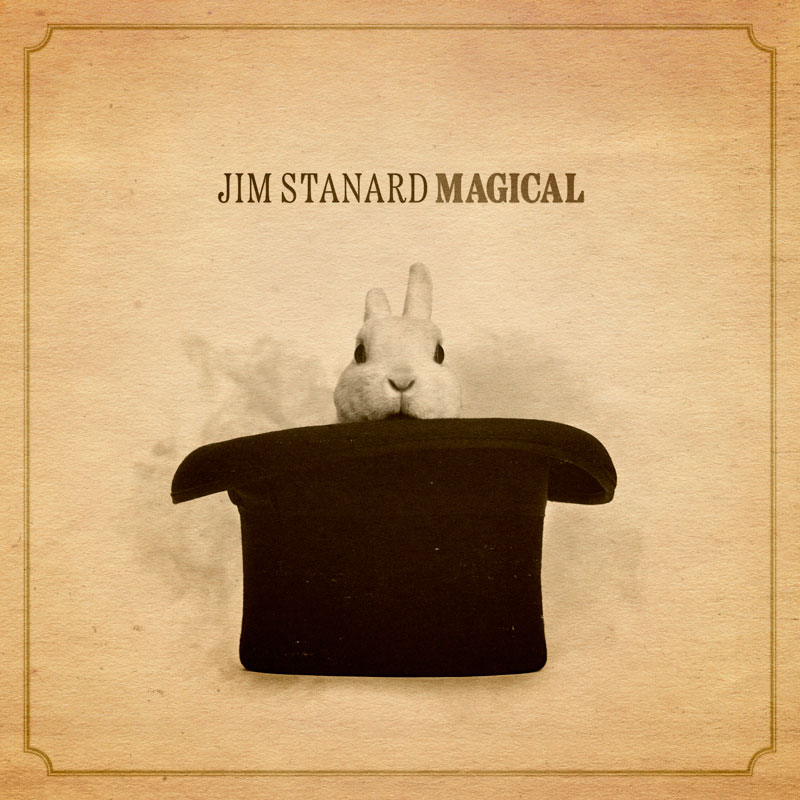
The songs for Magical were written over a period of four years. Jim says, “I had a couple of them already started by the time I put the second album out.”
As for the songwriting process, he says, “I’m very slow as a songwriter. I keep going back and revising and revising and revising over months.”
As for the album itself, Jim said there is no overarching theme. “I didn’t start with the album title. We started with ten songs. Then we were trying to decide what to call the album. So I don’t think there was a particular theme. And I like to have some variation in the styles of songs. So I have a couple of funny ones and some sad ones. Some straightforward rock and then some more Americana-style songs.”
The songs on Magical, and his previous albums as well, reflect the styles that he loves. He grew up musically listening to Bob Dylan, and Jim says Dylan is by far the biggest influence on him. “I saw him in 1966 at the Academy of Music on that great tour where he was half acoustic, half electric,” he recalled. “It was the first tour he did with the Band behind him.”
Jim is also a big fan of Warren Zevon, Robert Earl Keen, Mark Knopfler, and Kris Kristofferson. “So I really like historical stories,” he says. One example from Magical is the song “When The West Was Won,” a moving tale based on the Trail of Tears.
“I had the first part of the story,” Jim told me. “It was a kid playing and then the soldiers come and they (the Cherokee) are forced on the march. Some people liked it. But I was thinking, ‘What’s the point? Why is someone listening to this? It’s just a sad story for no reason.’ I wasn’t satisfied. So then I decided to pick up the story in later life, to have some kind of closure about what happened to this kid.”
The story picks up after “50 springs, 600 moons… when men came to his farm, told him to move again.” It was a move he wasn’t inclined to make.
If “When The West Was Won” is earnest in tone, “You Turned Red (That Made Me Blue)” is definitely tongue-in-cheek. It was the quickest song Jim ever wrote. “I wanted the whole song to be read as a double entendre. You can read it as the whole thing is a political song or the whole thing is a relationship song. Either way it makes sense. At least that’s the point.”
When it comes to politics, though, Jim personally is involved with Braver Angels, a group that tries to reduce polarization. The late Peter Yarrow introduced him to the organization. The idea is not to convert anyone but to try to understand each other’s point of view. It is an endeavor that is personally very important to him.
I asked Jim Stanard if he had any advice to offer to someone in their 60s or 70s who might want to pursue music or some other form of artistic expression. There were three parts to his advice.
“Start,” he says. “I see so many young people in their 50s who say ‘Oh, I’m too old for that!’ I mean, come on. You may have a lot more time than you think. People are living longer. So just try it and see where it goes.
“And repetition is more valuable than talent,” he says. “I believe the 10,000-hour theory of working on technique and practice. Work hard.”
It’s a humble take from someone who came to songwriting later in life, but it’s also clear that Stanard brings more to the table than practice alone.
“The third thing would be to find a mentor. Whatever you want to pursue, find someone who is really good at it to help you along your path.”
Sage words worth heeding, from a musician who’s lived the journey.
