


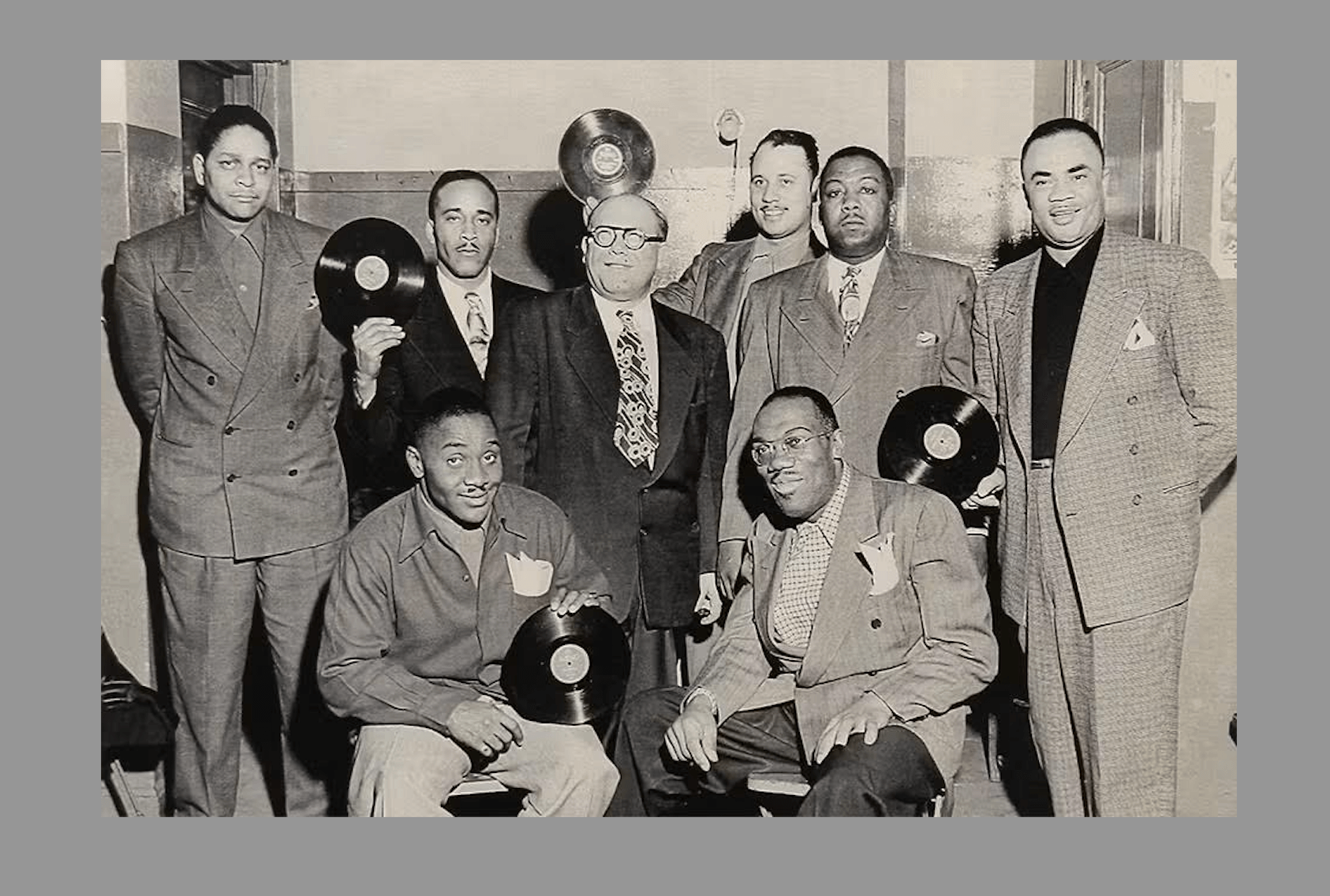
So you really must watch King of Them All: The Story of King Records, currently on demand at PBS and also in entirety on YouTube. In the days or formative R&B and rock ‘n’ roll, Memphis had Sun and later Stax, Chicago had Chess, Houston had Duke/Peacock, Shreveport had Jewel/Ronn, New Orleans had Imperial, and Cincinnati had King/Federal.
The PBS documentary traces the life of Syd Nathan, a Jewish native of Cincinnati, who launched King Records initially as a hillbilly and country label (Grandpa Jones, The Delmores, Moon Mullican). With the enlistment of staff writer and producer Henry Glover, a Black man who was as much at home with hillbilly as he was blues and R&B, King spawned a Black music initiative, eventually signing Hank Ballard & the Midnighters, Roy Brown, Bill Doggett (whose “Honky Tonk” instrumental is heard at the start and finish of the program), Champion Jack Dupree, Ivory Joe Hunter, Joe Tex, Johnny “Guitar” Watson, and Otis Williams & the Charms. Occasionally the country artists and R&B artists would record the same song, with very different takes.
There was also the Federal subsidiary label, and a staff producer/Chicago A&R man Sonny Thompson, who is not invoked — a photo of Freddie King flashes, but is never elaborated upon, although A&R man Ralph Bass (later of Chess) is given due credit. Moreover, Seymour Stein, visionary founder of Sire Records, began his career at King while a high school student and is interviewed, citing Nathan as his mentor.
Nathan couldn’t get vinyl pressings as fast as he needed them, so he created his own pressing plant on the premises. It was said that he’d occasionally record in the morning and press vinyl by nightfall.
Lightning struck when the label signed an Augusta, Ga. R&B singer named James Brown, although Nathan was none too pleased on first hearing “Please Please Please,” contending it needed more lyrics than “please” x 3. He was wrong, and the Godfather of Soul was born, as was the funk subgenre. King Records was officially on the map. Soul Brother #1 eventually outgrew King and moved to Polydor Records. Not one to stay put, Brown briefly detoured through Smash Records before returning to King. His recordings at Polydor (a unit of the PolyGram conglomerate) were not as successful as they were at indie King. (JB, on the downside of his hitmaking arc, did revert to the indies.)
Nathan never groomed a successor at King. There was no strong #2 officer. When he passed suddenly in 1968, the label, rudderless, was sold to country label Starday Records, which never re-ignited nor even reissued King to its fullest potential. The original King headquarters at 1540 Brewster Ave. in Cincinnati still stands, although apart from its historical marker (placed by the R&RHoF), you’d never suspect history had been made in the industrial space, looked pretty decrepit in its TV portrayal unless it’s been gussied up since the documentary filming.

The doc packs as much information and reflection into 60 minutes as it can, with many historians (James Brown biographer and former Cincinnatian RJ Smith among them, and several with whom I hadn’t been familiar) and Seymour Stein (who has since passed on) recounting the saga. Yes, it might have sustained two additional hours of detail for us hardcore history geeks. Nonetheless I highly recommend tuning in.
About the author: Born on Chicago’s South Side, Cary Baker began his writing career at sixteen with an on-spec feature about Chicago street singer Blind Arvella Gray for the Chicago Reader. After a forty-two-year hiatus during which he directed publicity for six record labels—including Capitol and I.R.S.—and ran two of his own companies, Baker has returned to writing. His artists included acclaimed artists such as R.E.M., Bonnie Raitt, The Smithereens, James McMurtry, The Mavericks, Bobby Rush, Willie Nile, and more.
Prior to his PR career, Baker wrote for Chicago Reader, Creem, Trouser Press, Bomp!, Goldmine, Billboard, Mix, Illinois Entertainer, and Record magazine. He has also penned liner notes for historical reissues from Universal, Capitol/EMI, Numero Group, and Omnivore, and has been a voting member of the Recording Academy since 1979.
In November 2024, Jawbone Press published his book Down On The Corner: Adventures in Busking and Street Music — a collection of interviews and stories spotlighting the lives of street musicians across cities like Chicago, New Orleans, Venice Beach, and Dublin. Baker describes the book as having “written itself,” a project through which he shared the untold stories of both legendary and lesser-known artists. He currently lives in Southern California.
Related reading:
- An interview with Cary Baker about Down On The Corner
- A classic Willie Dixon interview conducted by Cary Baker
- 110 Years of Willie Dixon: A Personal Tribute by Cary Baker
