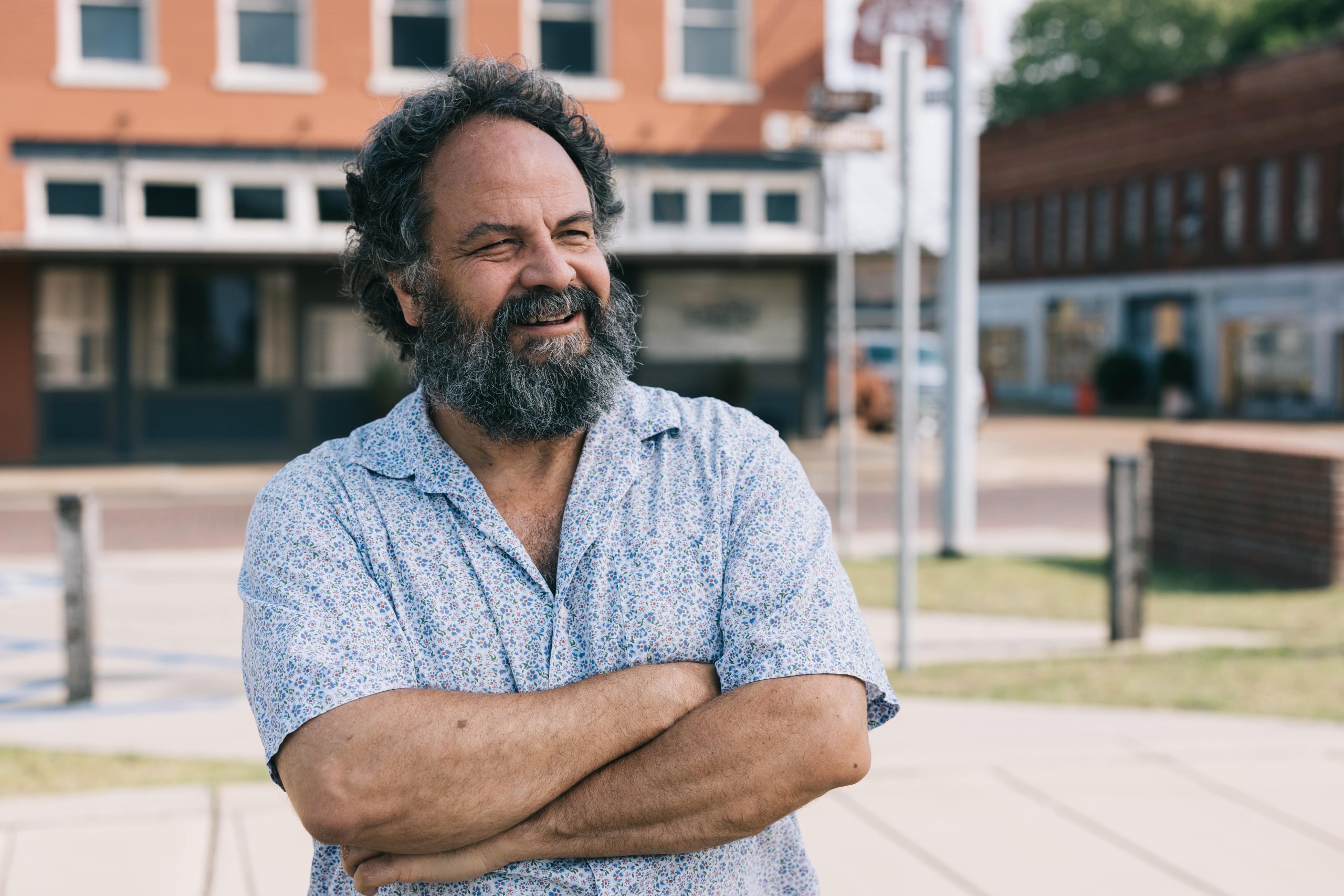
Scott Barretta, an instructor in the Department of Sociology and Anthropology at the University of Mississippi, the host of Mississippi Public Broadcasting’s hourlong blues radio show “Highway 61,” and the director of Shake ’Em on Down, a documentary on Hill Country Blues, sees Hill Country as a unique tradition.
While working as editor of Living Blues in the 2000s, Barretta produced a special issue on North Mississippi Hill Country Blues. Photographer Bill Steber produced iconic photographs of R.L. Burnside and Junior Kimbrough, accompanying text by Barretta for the blues magazine over the years.
Throughout the 1990s, Barretta visited Oxford, where he frequently attended Junior Kimbrough’s juke joint. He moved to the area in 1999.
Fred McDowell and Othar Turner loomed large as mythic figures in the community. Barretta said R.L. Boyce recounts how Turner had a mule-drawn wagon, and people could hear the pair approaching with slide guitar and drums as they arrived at three-day picnics.
In terms of the label, Barretta said Hill Country generally refers to musicians in Holly Springs, in Marshall County, and in the areas around Senatobia and Como to the west. Junior Kimbrough, R.L. Burnside and Othar Turner were associated with the region. McDowell was from Tennessee, but not far north of where Kimbrough and Burnside were located. McDowell later moved to Como.
Although the boundaries are not rigidly defined, the Hill Country Blues label can encompass at least five counties in northern Mississippi, including Marshall, Panola, Tate, Lafayette and Tippah, with musical connections extending into neighboring areas of Tennessee. The label is fundamentally cultural and musical, not a formally delineated region.
According to Barretta, David Evans takes an even broader view of the Hill Country, extending the label eastward into Mississippi and north into Tennessee. His conception can encompass musicians such as Booker White, from Aberdeen, and Big Joe Williams, from the Columbus area, as well as Tennessee-born Sleepy John Estes, from Brownsville. His definitions are based on geography and sound.
Fred McDowell: The Godfather of Hill Country Blues
McDowell was discovered and recorded by Alan Lomax and Shirley Collins in 1959 and featured on the iconic Atlantic LP Roots of the Blues. In 1964, he appeared on the Arhoolie record Mississippi Delta Blues, and in 1965, he appeared on My Home Is in the Delta for Testament Records. As the titles suggest, Hill Country Blues as a term did not emerge until much later, with the Fat Possum label, after Robert Mugge’s film Deep Blues in 1991.
Barretta’s Shake ’Em on Down documentary, released in 2017, delved into the history and context of Hill Country Blues and presented McDowell as a foundational figure.
“One of the points with our film is to situate Fred McDowell as kind of a godfather figure of that scene, and he certainly was a major influence on R.L. Burnside. Burnside borrowed a good bit from him,” Barretta said. “With Burnside you could hear Muddy Waters and Lightnin’ Hopkins, probably John Lee Hooker. But one of R.L.’s first performances was playing at a juke joint where Fred was the entertainment.”
According to Barretta, McDowell was the largest star of the blues and folk revival scene who had not made recordings prior to World War II. Other artists, like John Hurt, Son House, Skip James and Booker White, made recordings in the 1920s, 1930s and early 1940s before disappearing until the 1960s.
McDowell performed at the Newport Blues Festival in the early 1960s, where he befriended Bonnie Raitt. When he traveled to England, he met the Rolling Stones, who became among the most popular proponents of his music, delivering an iconic rendition of his track “You Gotta Move.”
“He was just regarded as this great slide player, and I mean the percussiveness. You hear his music and you want to dance,” Barretta said. “It was very appealing, and also he was pretty youthful. One of the reasons why he was popular was that he was just a very likable guy who was just himself wherever he was.”
According to Barretta, Bonnie Raitt hung out with McDowell, and he liked to joke around and was a great person. “Everybody loved the guy.”
From Obscurity to Recognition
Despite being on record since the late 1960s, R.L. Burnside was regarded as a minor artist, Barretta said. Hardcore collectors were interested in him, however, and knew him more as an acoustic player because that was how George Mitchell and others recorded him in the 1970s.
By contrast, in the wider blues field, Koko Taylor and Albert Collins garnered a much larger audience. A small, dedicated audience followed R.L. Burnside, Junior Kimbrough, Jessie Mae Hemphill and Othar Turner. Barretta said there was a small market defined by its interest in obscure musicians.
In the late 1990s, touring with Jon Spencer, Burnside gained a larger following, playing to halls that could hold 1,000 people, something unimaginable for him during his tours of Europe in the 1970s and 1980s.
Barretta said there was significant cross-pollination and collaboration between the Burnside and Kimbrough families. They were featured in the same blues publications, played the same festivals and lived in the same region. A key point in unifying the region and its sound, according to Barretta, was when Kenny Brown founded the Hill Country Picnic in 2006.
“It’s always about how we’re trying to keep up this spirit of community and keep these traditions alive,” Barretta said. “A lot more people have got to know the North Mississippi Hill Country label.”
Festivals, Commercialization and Community
Prior to commercialization and festivals, the Hill Country sound was preserved by Junior Kimbrough’s juke joint and similar venues in the region. When Junior’s burned down in 2000, the community lost a tangible part of its cultural life. While Turner’s Fife and Drum Picnic existed at the time, it was a once-a-year gathering.
“Even though you can sort of see commercialization as a negative force, you could also say that a lot of people actually got gigs because Clarksdale began to grow as a place where now you’ve got blues seven days a week,” Barretta said. “In the early 2000s there was blues a couple times a week, but there weren’t really gigs.”
Barretta said that in recent years the Hill Country Picnic and the Juke Joint Festival in Clarksdale have become the go-to festivals, supplanting the Delta Blues Festival in Greenville and the Sunflower Blues Festival. He added that Peggie Sue “Lady Trucker” Hemphill started a Jessie Mae Hemphill Festival several years ago.
“The Hill Country Blues is a pretty well established scene, and its base is the Hill Country Picnic,” Barretta said.
According to Barretta, a lot of younger Black musicians in Mississippi have wide repertoires to maximize commercial success, tailoring their sound to the Southern Soul that airs on the radio. They may play Southern Soul on Friday or Saturday night and then be hired to play in church on Sunday mornings. Many musicians maintain this flexibility.
However, Barretta said there is not much room for people to move within Hill Country Blues, with the same core of 20 to 30 musicians for years.
“There’s just a real core of musicians. It’s not a really big scene,” Barretta said. “But there are a bunch of people, white musicians, who kind of play in what they call a Hill Country style, a stripped-down style.”
Barretta also works with the Mississippi Blues Trail, placing markers across the state commemorating important places and people in blues tradition. The project started with a grant for nine markers, and the state legislature provided additional funding to install 120. Through the project, Barretta helped install historical markers for Hill Country, Fred McDowell, Othar Turner, Jessie Mae Hemphill, Napoleon Strickland and Sid Hemphill. After the Black Keys provided funding, markers for Junior Kimbrough and R.L. Burnside were erected. A marker also stands for the Dickinson family.
Carrying the Tradition Forward
For Barretta, Cedric Burnside has become one of the ambassadors of the blues, a remarkable distinction for someone who started out as a drummer. Reuniting with Gary Burnside, the brothers are able to switch between playing guitar and drums together live. Cedric reinvented the Hill Country sound with a staccato quality to his guitar playing, Barretta said.
Sharde Thomas is also reinventing fife and drum music from the Hill Country. Barretta said that historically, a snare, a tom and a bass drum were used, but Thomas now doesn’t always use the tom drum, instead performing with two drummers.
“Sharde and her husband are opening festivals. They often don’t do sets longer than 30 minutes,” Barretta said. “But people are booking them for that very distinctive kind of form of folklore. It’s a sound that most people in America still don’t know about — Black fife and drum bands.”