


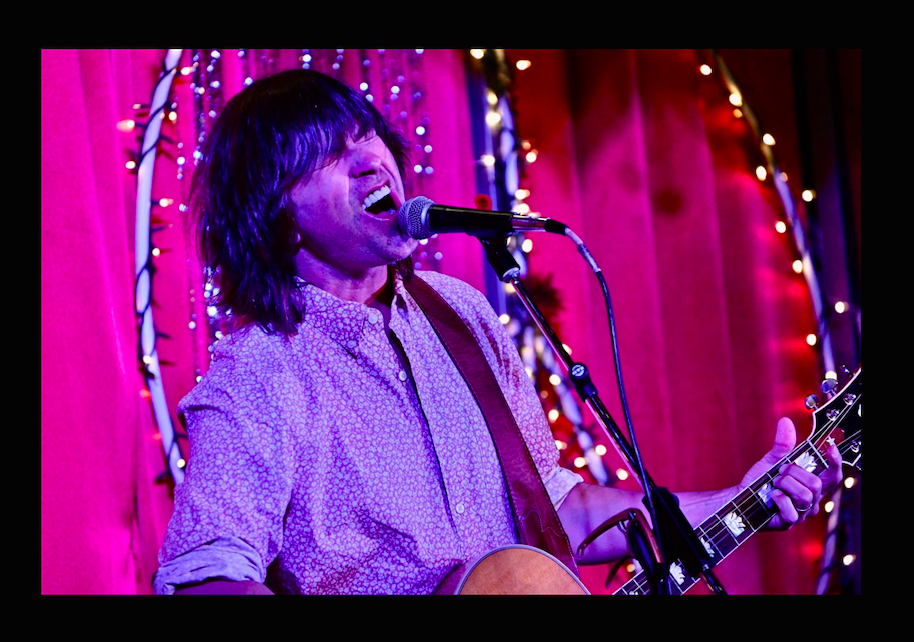
The answer to the lyric “What’s so fine about art?” comes easy on a night like tonight. Iridescent mirror mosaics catch the light, opalescent pearls and pink hues fill every corner of my vision, and sweet volunteers greet me by writing my name on masking tape to mark my seat. The instant mood shift hits when I close the car door and step into the kaleidoscopic dimension of Safety Harbor Art and Music Center (SHAMc). What better place to see Rhett Miller, singer-songwriter of the Old 97’s, whose songs can disarm and reset my world?
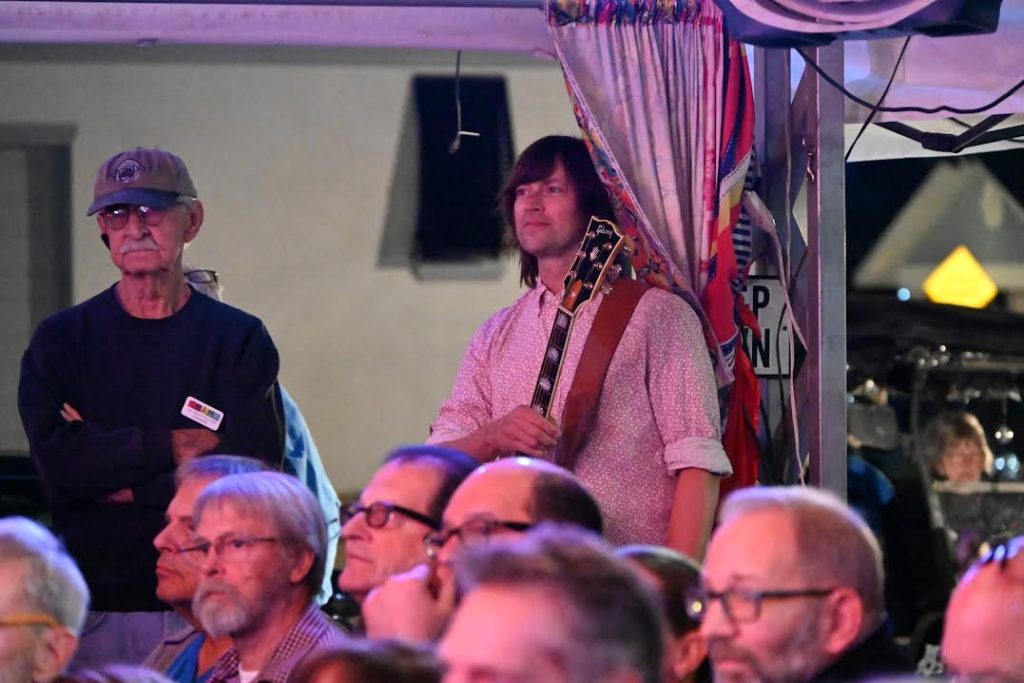
“I was rushing to get down here because I was up in the cool dressing room working on a song.” Looking at him, he’s levitating on a frequency most musicians never find — even someone like him, 33 years into the same band. He’s the kind of performer who’s already glowing before anyone realizes he’s being called to the stage from behind the audience in this nonprofit’s sold-out listening room.
That natural high comes from musical individuality, self-discipline, and gratitude for “where the road goes,” even the rocky bits. His vocal range still hits the highs and suspends in the lows, which feels no small thing considering that a year ago he underwent vocal cord surgery. A songwriter’s voice, after all, is born, not manufactured, and what’s meant to be is meant to be. There was a real chance he might never sing again, yet he still sings with his whole chest, larynx intact — that “loud folk”-making instrument he was born with.
If you think energy would be dialed down by the stripped-back nature of a solo acoustic set, a Rhett Miller show quickly proves otherwise — starting with the first song. “What remains of the day remains to be seen,” he sings in the opening lines of fan favorite “Jagged.” Ken Bethea’s duly jagged fuzz tone may be absent, but Miller’s voice still takes wing with the chorus, his body keeping time as he deploys that trademark “windmiller” move–an elbow so improbably double-jointed it’s inspired an entire Reddit thread questioning whether it’s a special effect in the Guardians of the Galaxy Holiday Special.
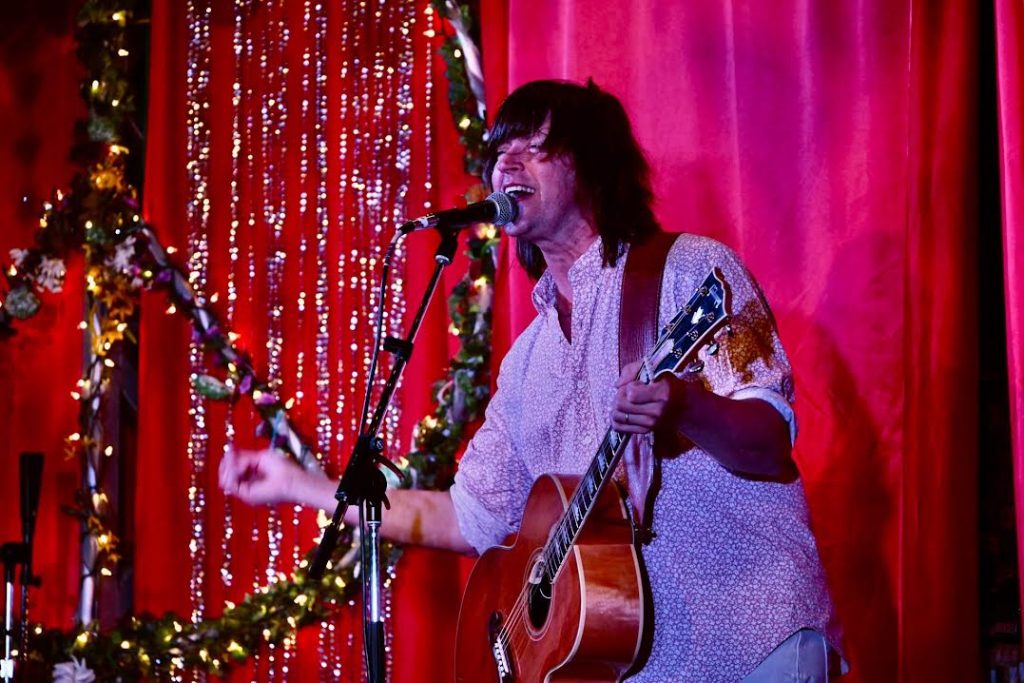
Fast, percussive strokes from a relaxed, unrestrained wrist feed into an acoustic version of “Won’t Be Home,” and he’s banging his head along. The genius of the song lies in how completely it trusts its own contradiction. It doesn’t ask the listener to choose between agony and ecstasy; both arrive at once, barreling forward on the same defeated breath and brilliantly defiant melody. These are the kinds of songs Tom Petty mastered. Songs that steady the bad days in their own unsteadiness naturally hold the power to heighten the good ones through earned reckoning. I feel like those who grew up living inside Tom’s emotional shorthand can recognize lines that function less as lyrics than as inch-perfect, compressed literary devices.
While Miller has mentioned that it pays for his daughter’s entire tuition, it’s no accident he teaches songwriting at The New School in Manhattan. Arcane fan Beth Holliman, who made the trek from Orlando and who quite literally sang all the words to all the songs, shouted out “And StageIt doesn’t pay for it,” referring to the online platform utilized to stream shows and make up for lost income during pandemic panic. He laughed, “So, my online performances. Not even my real life performances.”
About the vocal surgery, he celebrated, “It worked! It worked. You be the judge,” he says, before launching into “This Is What I Do,” immediately climbing to an upper range. The always-standout “Curtain Calls,” where Miller’s chest voice blooms, was followed by another live staple, “She Loves the Sunset.” After explaining who Annette was (something I’d always wondered about), he played “Designs on You.” Every time I revisit the recorded version, it still feels perfectly calibrated to its era, richer with each listen and carried by a guitar tone that swells with its bruised mood. “Come As You Are,” written with Evan Felker of Turnpike Troubadours for Miller’s 2025 solo effort A Lifetime of Riding by Night, flowed fluidly into this part of the set – as did the sharp economy of “Indefinitely.”
Rhett Miller is country the way Rodney Crowell is rock and roll, and rock and roll the way Crowell is country. Hear me out. When the songwriter understands they are not separate rooms, you get an intentional, hinge artist who writes the doorway and feels at home. Hitting that narrow mark, precious thin, is its own marvel. The kind of understanding at work in songs like Rodney Crowell’s “Ain’t Living Long Like This,” where in the first blink the guitar skitters into rapid-fire ricocheting like bullets bouncing off tin cans. Living embodiments of that guitar figure, Old 97’s are a band built around the same idea: rock and roll mischief disciplined just enough in service of a country song, and country storytelling that tolerates a little noise.
Introducing “Good With God,” Miller joked that in the song and probably in real life, God is a woman. Maybe, he mused, he shouldn’t be putting words in the mouth of a female God at all, lest he wind up in “female God hell.” So he did the next closest thing and asked Brandi Carlile to help write it. She agreed, but with one condition: the guy was going to get what was coming to him.The recorded track rolls like a train on rails of reverb; solo, Miller keeps it moving, then touches down on “Big Brown Eyes.”
“I got in a little hot water with my family down in Texas,” he says, introducing “Jesus Loves You.” Having sung in three different choirs, gone to an Episcopal boys’ school, and attended church four or five times a week, he figured he’d already frontloaded the devout years. “I don’t like him either, guys,” he jokes, nodding to the narrator of the song. Next came “Fireflies,” originally conceived as a George-and-Tammy-style duet, with the female part written for X singer Exene Cervenka. “‘Rhett, you know I don’t sing like that,’” he recalled with a gruff impersonation. He turned his head from one side to the other to voice each part, facing down the middle when they sang together — embodying both genders at once, like an earthworm. “They can procreate independently,” he added, deadpan, “which is something my guitar player tells me I should do.”
“Where the Road Goes” from the Old 97’s latest record, American Primitive (2024), shone as a gracefully powerful highlight of the set, almost an unofficial, heartening longview companion to 2014’s “Longer Than You’ve Been Alive.” While the latter looks back on life on the road and jumps off risers, the former stays curious once it lands, surveying the same terrain with a gentler perspective. In his songwriting class, they have a rule that if someone gives you an idea and you do it, they can’t come after you for 50 percent of publishing rights. “It’s a little gift you give somebody.” Miller didn’t realize this in the mid-’90s but his Uncle Ed of Ft. Worth, Texas gave him a little gift when he said “I’ll stomp a mudhole in your heart,” a less vulgar variation on the original Texas saying. With that, he performed the singalong “Bel Air.”
Dean of American Rock Critics Robert Christgau once noted that “the Old 97’s were long pigeonholed as an alt-country band. They never were—just a rocking quartet with a terrific songwriter up top named Rhett Miller… In these post-Tin Pan Alley days, most good songwriters play with the first person so it’s impossible to know what’s life and what’s art—that’s part of the power of the form.” Life meets art in the next song, “Murder or a Heart Attack,” where the one who got away is a cat named Charlie. True story.
Miller’s 19- and 22-year-old kids are only now discovering his catalog. In New Paltz, NY, he was always the dad singing to a handful of kids in a cafeteria, attention split between him and the canapés. In the case of the next song, he shared, “My son said, ‘Yeah, I think this is one of your best songs.’” Miller guessed he meant a clever chord change, then laughed at his own misguess. “If I knew it was that easy,” he said. “I Used to Write in Notebooks” navigates the subtle dislocation of a world in flux: notebooks, maps, dial tones, and waiting on hold for time and temperature give way to answers “pulled from the sky.”
“This next song I wrote with Bob Dylan.” Just kidding. Sort of. “Champaign, Illinois” borrows its melodic spine from “Desolation Row,” and is perhaps Miller’s most Dylan song: a wry, wandering narrative with repeated refrains, oddball moral observations, and specific geography — as witty as it is irresistibly fun to sing along to thanks entirely to Miller’s own phrasing and timing. He held the song back for about a decade until a manager who knew Dylan’s manager could help clear it. “And Bob Dylan wrote an email that they forwarded to me, which means that I am now best friends with Bob Dylan.”
Referring to a Rolling Stone listicle, he questioned the state of journalism and how we tie ourselves in knots over rankings. The higher he got into the article, it was obvious the ragebait had done its job. But by the end, he had an epiphany: “Anyway, here is the 229th Greatest Song of the 21st Century So Far.” Cue “Rollerskate Skinny,” a number that skates along with characteristic energy. Then, “Come Around” tucks unrequited longing inside tempered sunlight. He said he had a couple more songs before pretending to leave – that old show-business trick no one even likes, he admitted. We all laughed because he was right.
So began the crowd pleaser “Doreen.” And noticing that there were some younger folks in the crowd, he apologized in advance for the bad words before dedicating “Longer Than You’ve Been Alive” to anyone born after 1993. A victory lap–does-doughnuts of a song, long since crossed into canon, Rosanne Cash worked it into her induction speech at the Ryman, using it to underscore the artistic dedication that earned them their Americana Lifetime Achievement Award.
Coming back from behind the curtain, Miller acts surprised, “primarily because there’s nothing back there. Just a wall. If you hadn’t brought me back I would have had to stand there.”
“Question,” which he wrote 25 years ago, is one of the most frequently used proposal songs in film, television, and advertising. And yet, as the writer, he forgot to play it when he proposed to his wife, who was in the audience. “Oh shit, I had the perfect song,” Miller quips. He then turned to “Our Love,” inspired by Wagner’s and Kafka’s scandalous letters.
As he tees up the encore, he notes that he doesn’t get to play Florida often, but when he does, he thinks of “this guy.” Even stripped to acoustic, nothing drains from the charge in this rendition of “American Girl.” Letting the lines hang just a beat longer, he leans on his voice and acoustic guitar to power what the Heartbreakers would, sending the crowd cresting in a Florida wave most sacred of them all.
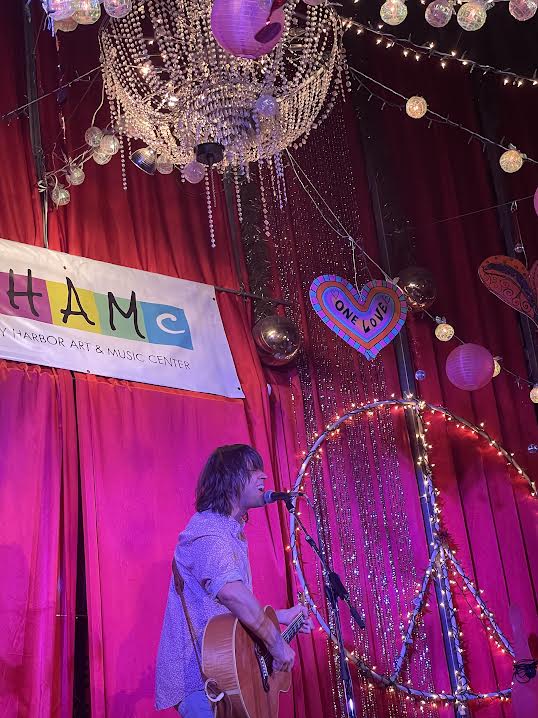
In keeping with his confident command of vocal range and closing the night on a signature slap, “Timebomb” detonated and reminded us fans why it remains an irrepressible Old 97’s touchstone.
Rhett Miller continues his solo tour, next stop Los Angeles’ Largo at the Coronet on February 20 and closing in Montclair, NJ at Outpost in the Burbs at the end of April, before joining Old 97’s on tour from late March through late July.
