


Reports vary on his date of birth. But Charley Patton, one of the earliest blues artists on record*, is said to have been born 134 years ago this month in April 1891 (exact date and year unknown), in Hinds County near Edwards or Bolton, Miss. (source: Mississippi Writers & Musicians website). But whatever his actual birth date, it’s never a bad time to pay tribute to this Mississippi Delta blues forefather.
What generally IS agreed upon, however, is that Patton passed away 92 years ago today on April 28, 1934.
Critic and author Robert Palmer considered Patton to be one of the most important American musicians of the 20th Century. And indeed, he was influential on the next generation of early blues artists: Robert Johnson, Bukka White, Skip James and Son House.
Patton performed at Dockery and other nearby plantations, and collaborated with Willie Brown, Tommy Johnson, Fiddlin’ Joe Martin, Robert Johnson, and even a young Chester “Howlin’ Wolf” Burnett.
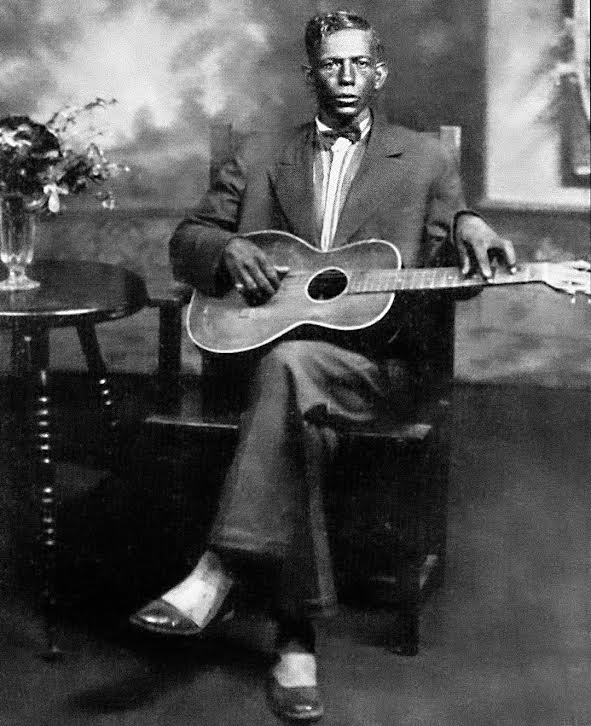
Patton was said to be part Black, part Native (espoused by Mississippi Blues Trail, City of Clarksdale web page, Oxford American and The Guardian). In his 1929 Paramount recording, “Down the Dirt Road Blues,” Patton sang of having gone to “the Nation” and “the Territo” – the Cherokee Nation’s portion of the Indian Territory (which became part of the state of Oklahoma in 1907) – where a number of Black Native Americans tried unsuccessfully to claim a place on the tribal rolls which determined land claims.
Other Patton classics – all recorded at Paramount’s studio in Grafton, Wis. – include “A Spoonful Blues,” “Peavine Blues,” “Shake It and Break It (But Don’t Let It Fall Mama),” “Pony Blues,” and his recount of the 1929 Great Flood of Mississippi, “High Water Everywhere.” Occasionally he was accompanied on record by his common-law wife, Bertha Lee Patton, and/or by fiddler/mandolinist Henry “Son” Sims. Patton has historical markers along the Mississippi Blues Trail in Holly Ridge and Boyle, Miss. His tombstone, funded in part by John Fogerty, features an epitaph written by Living Blues magazine co-founder and blues historian Jim O’Neal.
Patton recorded again five years later in 1934 for Vocalion Records, with sessions in New York City. He died shortly thereafter at age 43 (give or take) on April 28, 1934.
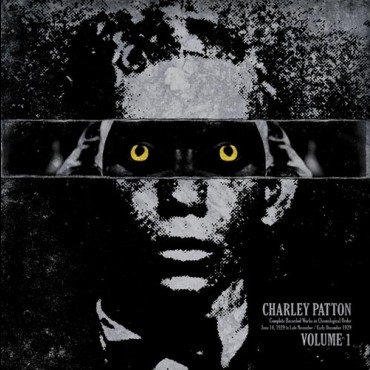
Patton’s long-posthumous 6-CD box set Screamin’ and Hollerin’ the Blues: The Worlds of Charley Patton on John Fahey’s and Dean Blackwood’s Revenant Records, is considered the definitive collection of his works, winner of three Grammy awards, for Best Historical Album, Best Boxed or Special Limited Edition Package, and Best Album Notes. (Patton is one of Fahey’s greatest influences.) In addition, Third Man Records released The Complete Recorded Works in Chronological Order on vinyl in 2013, adapted from a late 1960s Document Records reissue.
[*Note: There is at least one earlier country blues musician on record: Henry Thomas (1874 – 1930). Bob Dylan recorded his 1927 “Honey, Won’t You Allow Me One More Chance” on The Freewheelin’ Bob Dylan, and his “Fishing Blues” is a folk/blues standard.]
