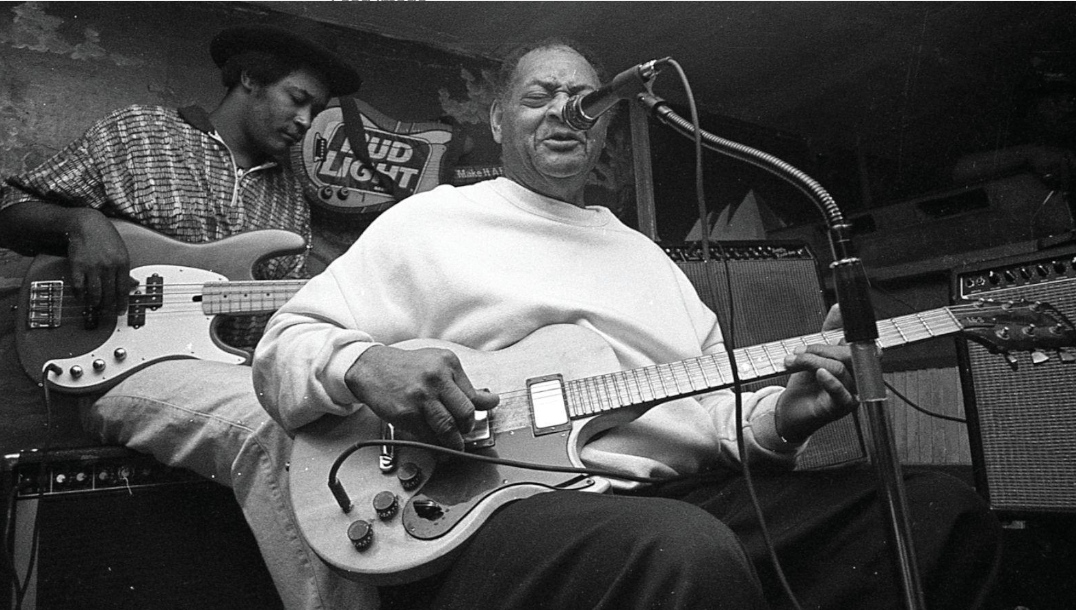
Junior Kimbrough
In 1968, Junior Kimbrough cut his first single, “Tramp,” for the local Philwood label. Evans heard the record on 45 when it came out, but did not encounter Kimbrough in his fieldwork in the 1970s. One of Evans’s graduate students, Sylvester Oliver, who grew up in Holly Springs, introduced Evans to Kimbrough in 1979, taking him to a club at the outskirts of town.
Evans, who up to that time mostly did fieldwork, recording people in their homes or at picnics, was “really knocked out” by a stellar performance in the club, with couples dancing and Kimbrough performing what were clearly original songs.
“All of his pieces were original. They weren’t very complex, at least in a lyrical sense. A lot of repetition and musically, they used repeated riffs. But they were quite original,” Evans said. “They had odd structures. He had his own sound. It was within the general parameters of Hill Country sound, especially the use of the riffs, but it was all his original material.”
While he covered “Catfish Blues” and “Black Mattie,” perhaps a few standards, over 90% of what Kimbrough played was original music. And all of it was designed to be dance music, Evans said.
Evans booked Kimbrough at several festivals, but back home in Mississippi Kimbrough would play on his front porch for small crowds most Sunday afternoons. While he travelled internationally as his following grew, Evans said Kimbrough was never fully comfortable away from home. While he projected to the audience on stage, in between songs he was reserved and he lacked the outgoing nature that R.L. Burnside possessed, according to Evans.
Within the community, when musicians sat in with R.L. or Junior, the sitters-in adapted to their style. They were both respected for their unique sound.
“I think his originality [made him great]. I mean, he created a Junior Kimbrough sound. It was unlike anyone else’s,” Evans said. “It had some general Hill Country characteristics, but 90% original songs. That’s pretty unusual, even for full-time professional blues artists.”
Robert Belfour
Robert Belfour, who Evans described as “very good,” played a repertoire largely of covers and traditional pieces with a great voice and a Hill Country riff-based sound. Evans first saw Belfour play at Handy Park on Beale Street in Memphis, a popular spot for blues busking in the 1980s and ’90s.
“He had this really shitty amp, terribly distorted and he’d run his microphone through it as well. It sounded awful in one sense, but great in another,” Evans said. “I mean you could hear the greatness through the awfulness. I encouraged him.”
Despite first hearing Belfour play in 1980, it wasn’t until 1994 that Evans got the chance to record him, for the German Hot Fox label, producing The Spirit Lives On: Deep South Country Blues and Spirituals in the 1990s. Evans proceeded to tour with Belfour in the 1990s and 2000s, venturing as far as France and Germany, playing a Hill Country sound.
Like many Hill Country artists, Belfour worked a day job, and before the international tours, he mostly played house parties in out-of-the-way places.
Evans said Robert Belfour developed a distinctive approach to tuning his guitar. Although he used standard tuning, he raised the G string and left it open, creating a built-in blue note. Playing primarily in the key of E, Belfour used the tuning to produce the bent notes and tonal variations characteristic of his style. Evans said Belfour was influenced by John Lee Hooker and Lightnin’ Hopkins, and often built his playing around pentatonic blues scales.
“They were mostly pentatonic blues scales with that one blue note built into the tuning itself,” Evans said. “In the key of E, you can get a lot of blue effects by tuning to strict standard tuning and hammering on the third string of the G string.”
Napoleon Strickland
Napoleon Strickland was “kind of a strange guy” but “well-respected for his music,” Evans said.
“I was in awe of the power of his [Strickland’s] music. He sometimes was sloppy or just seemed to be off, but when he was on, he was great,” Evans said. “I mean, he had the most powerful rhythm of any musician, even Fred McDowell. But he wasn’t as consistent as Fred. And he wasn’t as great a singer as Fred and didn’t have as broad a repertoire.”
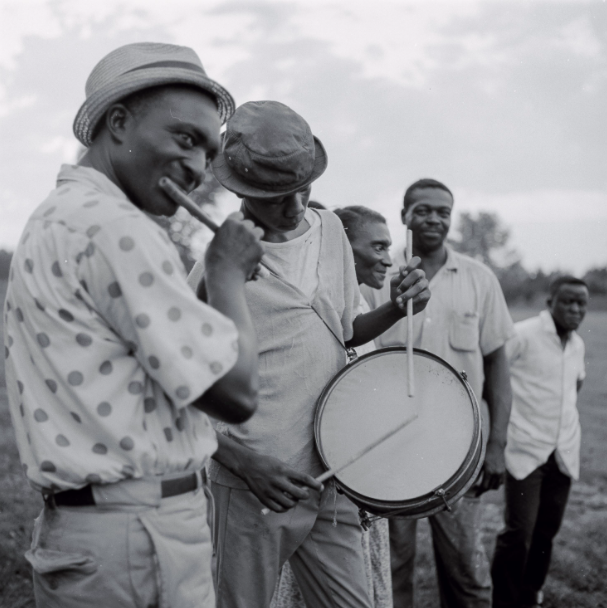
Evans added that at his best, Strickland was amazing, and that he was capable of playing harmonica, guitar, fife and the one-string. Evans said that Strickland was a better fife player than Othar Turner, but that Turner was the better drummer. Turner regularly hired Strickland to play fife with him.
From local tradition to international attention
Evans said the Hill Country community clearly retained a lot of the music and tradition, and that it was viable; not simply memory music from people dying out. People still actively hosted picnics in the region, which Evans attended in the 1970s and ’80s. In an attempt to capture the thriving scene, Evans recorded Jessie Mae Hemphill, R.L. Burnside and Junior Kimbrough on the High Water label.
Through his recordings in the 1980s, with his university label, Evans helped R.L. Burnside, Jessie Mae Hemphill and Junior Kimbrough get festival gigs and tours in Europe. He said that Fat Possum helped reach a pop and rock audience through branding and collaborations with rock musicians.
In 1982, Evans got a call from the children’s television show Mister Rogers’ Neighborhood, asking for a fife-and-drum band. Evans assembled Jessie Mae Hemphill, Othar Turner and Abe Young. Millions of people saw the show, including Jim Dickinson’s sons Luther and Cody, who went on to form the North Mississippi Allstars and collaborate with Othar Turner.
The recording projects from the 1960s through the 1980s captured the music as it was in the community, Evans said. The music remained largely unchanged.
“They presented the music of the community as it was. There were some little outside elements, but they were secondary. They didn’t really change the sound,” Evans said. “They didn’t alter the basic Hill Country quality of the music.”
Fat Possum brought in rock stars and elements, remixing Hill Country music. According to Evans, the label tried to change R.L. Burnside’s image and sound into something he wasn’t. Evans said, however, that Fat Possum built off his legacy at High Water, with the aim of bringing greater exposure to Hill Country artists.
According to Evans, Fat Possum manipulated Burnside and his family band, the Sound Machine’s sound. As an academic, he tried not to alter anything in his 1980s recordings.
While successful, and while it generated Burnside and the label significant revenue, Evans found the way Fat Possum marketed Burnside tasteless. He added that Burnside lived in a world where violence was common, so it was possible he could have killed somebody, but it was equally possible it was made up.
“R.L. was a jokester, a storyteller, a kind of epic lucky fellow. But serious in one sense. He kept his family together. He worked his day job, but he liked a good time,” Evans said. “He liked to be the center of attention. But he was marketed as this sort of bad man. You never entirely knew whether he was pulling your leg or just making a story or whether he was really telling you the truth about things that he’d done.”
While there is a certain outlaw quality to all blues music, Evans objected to the outlaw image Fat Possum promoted for Hill Country artists, and particularly R.L. Burnside. Evans attended Burnside’s parties in the 1980s, and while they were rowdy, he remembered R.L. as a man who took care of business, drove a tractor during the day and supported a big family.
“He wasn’t an outlaw,” Evans said. “Maybe they sold beer illegally and moonshine.”
Matthew Johnson, founder of Fat Possum Records, has overlooked the earlier work of researchers and musicians like Evans, at times suggesting that little had been done to promote or document the music before the label arrived.
What remains
While local gigs still exist, Evans said the tradition is largely being carried on by a few families, through festivals catered to a white national and international audience.
“It boiled down to a few families. It’s not what it would have been, if, only if it had never been encountered by researchers,” Evans said. “The music still has an authenticity to it. Certainly the performers would say they’re authentic, and they’re descendants of some pretty great blues musicians.”
Evans added that picnics in the past were less formal, with musicians stepping up contemporaneously. Today, the GOAT Picnic, the Hill Country Picnic and the Cotton Patch Soul Blues Festival have shifted toward formal festivals, with set lineups.
Evans said that the GOAT Picnic has been turned into a festival, with a predominantly white audience. Evans himself has performed authentic Hill Country blues at the festival.
“Maybe that [shift in audience] was inevitable. I can’t say whether community picnics would still exist today if there had been little or no or none of this white interest in it,” Evans said. “If Fat Possum had never come along and continued recording those artists.”
Evans said Hill Country blues remained particularly active within the community through the 1980s and ’90s, sustained in part by the region’s geographic isolation and distance from mainstream cultural centers. In more recent decades, he said, outside interest and the commercial success of artists such as R.L. Burnside and Junior Kimbrough have helped sustain the tradition. But that attention has not necessarily translated into widespread participation among younger generations outside the musicians’ own families.
“I think most younger people probably respect the success that the Burnsides and Kimbroughs and Turners have achieved. But they don’t seem to be taking it up themselves,” Evans said. “Maybe because the music is so far outside of the mainstream of current popular black music. It’s not rap, it’s not R&B, it’s not a vocal group or soul music.”
Evans speculates that the largely white audience for Hill Country today may be a turnoff to young Black potential musicians in the community.
Fife-and-drum music is not doing well, Evans said. The tradition thinned out in the 1980s, with Othar Turner and Napoleon Strickland keeping up the mantle, along with the Young Brothers. Later, the popularity of R&B and rap among younger audiences hurt the music. Sharde Thomas’s fife-and-drum band keeps the music alive today.
Yet, despite changes with Fat Possum and younger musicians, on the whole, the music has retained its Hill Country quality, according to Evans. Even with Sharde Thomas and her evolution of fife-and-drum music, the sound is deeply rooted in the traditions of the region.
While northern Mississippi has lost some of the picnic culture it once had, with backyard music parties most weekends during the summer, Clarksdale has developed into a permanent blues economy, with gigs every night of the week, Evans said. The Hill Country also became less isolated, with development. In the 1970s Interstate 55 helped connect the Hill Country to Memphis, allowing residents to commute for work.
Yet most of Evans’s work was recorded with the older generations of Hill Country, born between the 1920s and 1940s. In his fieldwork he also sought to document the broader musical life in the Black community, including banjo music, gospel and children’s songs. That said, Evans recorded R.L. Boyce at 15 and recorded Duwayne Burnside playing drums with his father.
Evans toured with Hill Country musicians in multiple capacities – as a road manager, a liaison between musicians and promoters, as an opening act and as a supporting guitar player. Evans occasionally joined Belfour on stage, and played guitar on all of Jessie Mae Hemphill’s songs on multiple tours. While Evans didn’t typically join R.L. Burnside as a guitarist, he played guitar with Burnside’s touring partner Hammie Nixon. Occasionally Evans sat in with Napoleon Strickland.
Learning Hill Country blues was a process that took decades. Evans began playing blues guitar in the 1960s, at first listening to records, and then watching musicians on tour. Early on Evans was able to see Mississippi John Hurt, Skip James, Sleepy John Estes, Booker White, Son House and Fred McDowell. Through fieldwork, Evans got a closer look at the musicians he had first heard on vinyl.
“I was right there recording them and watching and listening and that’s how I learned. You get off by yourself and try to sound like what you’ve seen and heard,” Evans said. “I’ve made up a few songs and all my pieces are arrangements. I don’t try to play note for note, word for word. But I try to play in the style of the other artists.”
Evans recorded as an accompanying guitarist with Jessie Mae Hemphill and Hammie Nixon, and more recently has worked as a session artist. On Candace Ivory’s recent CD, New Southern Vintage (2025), Evans plays guitar on several tracks. Since 1979, Evans has maintained some form of a jug band, and currently heads the Last Chance Jug Band. Last Chance Jug Band formed in 1989 and released its debut album, Shake That Thing, in 1997.
According to Evans, Black folk music largely exists in revival phases today. In similar conditions, urban blues has hung on in Memphis and Chicago, and Zydeco has found success, Evans said. Hill Country is largely defined by its community aspect. While other regional styles could boast strong blues artists, they lacked a connection to community, according to Evans.
“They [in Hill Country] were part of a community that had a rich tradition of music and they performed it for the community without too much influence from commercial music,” Evans said. “It was still a thriving, inward-looking music in the ’70s and ’80s. The longevity of it was a little bit unusual. That perhaps speaks to the strength and the quality of the music.”