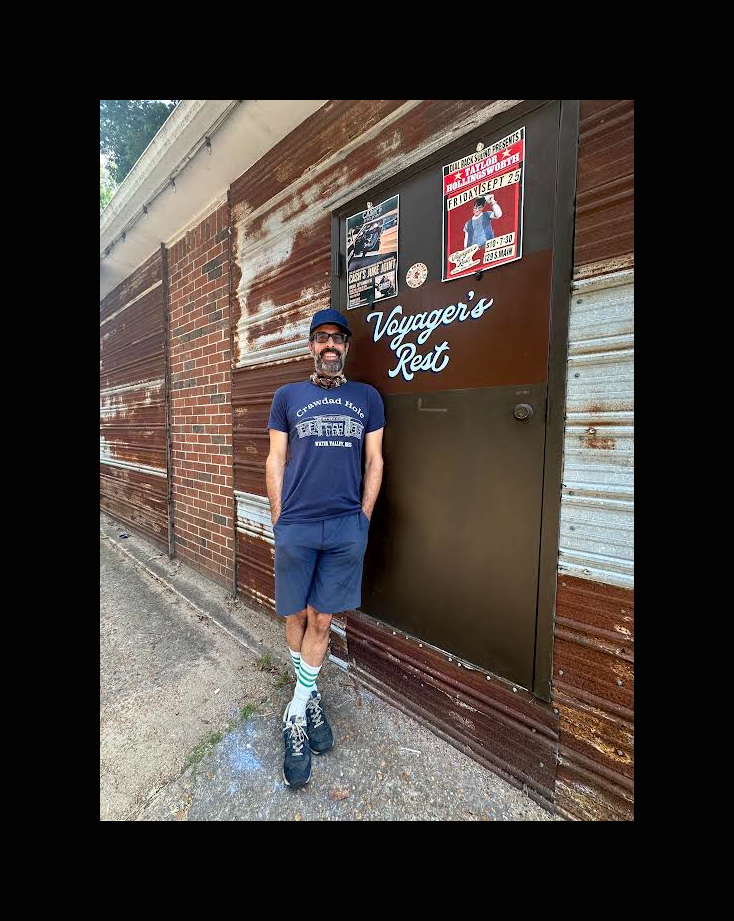
Some of North Mississippi’s most memorable blues performances were never recorded. For Justin Showah, a Mississippi-based bassist who has spent years performing alongside and documenting Hill Country musicians, those fleeting moments capture something essential about a musical tradition rooted in community, improvisation and shared experience. Showah’s involvement in Hill Country blues extends well beyond the stage. He plays in Afrissippi, works as a sound technician, owns a restaurant and music venue, and founded the Hill Country Records label.
While attending the University of Mississippi, Showah discovered the music of R.L. Burnside and Junior Kimbrough and fell in love with Hill Country blues, initially watching the scene as a fan from a distance. He remained connected to the genre while forming his own rock band. In 2000, while serving as the house band for a radio show in Oxford, Mississippi, Showah met Guelel Kumba, a Senegalese guitarist who played traditional Fulani music. Kumba blended Hill Country blues with West African traditional music through his project Afrissippi. Years later, Showah would join the band.
Showah said Oxford’s music scene in the 1990s was particularly vibrant, with live music playing at numerous venues throughout the week. Alongside musicians like Burnside and Kimbrough, the city supported rock, jazz, soul, indie, bluegrass and alt-country. Proud Larry’s was a central spot for blues, according to Showah, who said the music’s popularity has declined in the ensuing decades.
The hypnotic sound of Hill Country blues
The hypnotic quality of Hill Country blues was what first drew Showah to the genre.
“That hypnotic element, the repetition of a pattern and lack of changes. Everybody kind of plays the melody, and you get in this trance,” Showah said. “You lock into a pattern and just don’t move, until it kind of incites this trance in the listener and the musicians.”
One of Showah’s early mentors was L.C. Ulmer, from Piney Woods, Mississippi. Together, they performed, toured and produced music. Showah plays bass on Ulmer’s 2011 album Blues Come Yonder. According to Showah, Piney Woods holds a unique blues tradition, distinct from the Delta, that emerged out of the region’s timber camps.
Ulmer’s influences included Delta blues, trance music and rock and roll, Showah said. Bo Diddley grew up in the same region. Over the years, Ulmer and Showah exchanged letters, and Showah booked Ulmer for various gigs and performances with his band. Ulmer loomed large in Showah’s life, almost like a mythic figure.
“It’s like meeting John Henry or Paul Bunyan or Tom Sawyer, like, are they real or not? His [Ulmer’s] life experience was so vast, and he was so eager to share that with everybody,” Showah said. “He’s one of the kindest people you’ve ever met in your life. The guy was just a wealth of information and wisdom.”
Ulmer left home at 14 to drive spikes on the Pontchartrain Bridge, headed west, served in the military and eventually returned to Mississippi. Amid racial tensions, he left for Illinois, where he spent 35 years as a truck driver and one-man band. Showah recalled his wealth of practical knowledge and anecdotes, from home remedies involving whiskey and pine needles to keeping snakes away and working on cars. In addition to guitar, Ulmer played banjo, mandolin and piano.
Despite decades of performing and his reputation as a talented multi-instrumentalist, Ulmer left behind a relatively small recording catalog. According to Showah, Ulmer purchased a reel-to-reel recorder in the 1960s and used it to record himself and other regional musicians. Much of his musical life, however, unfolded outside the recording studio. Between running a garage and working as a truck driver, Ulmer primarily played weekend gigs, including performances in Joliet and Chicago’s South Side.
His first released recording came almost by accident. In 2007, Ulmer and Showah traveled to Italy to perform at a blues festival, where organizers recorded their set without the musicians initially realizing it. Afterward, the organizers asked permission to release the performance as a festival sampler. The resulting album, Long Ways from Home, became Ulmer’s first release.
Showah eventually persuaded Ulmer to record a studio album in Como, Mississippi. Recorded in a single day, Blues Come Yonder (2011) was released on Showah’s Hill Country Records. Showah had initially hoped to capture Ulmer as a one-man band, believing his decades of playing that way would make for a compelling recording. But Ulmer preferred playing alongside other musicians, and Showah ultimately accommodated that preference.
Showah said Ulmer’s limited recording output also reflects a broader tradition in which music was valued more for its role in everyday life and community gatherings than for its commercial potential. Hill Country blues grew out of informal settings such as barn dances, picking parties, cotton fields, timber camps and rural juke joints, where musicians played to entertain one another or find relief from hard labor. In that context, recording was never necessarily the point.
Showah questioned whether recordings could ever fully capture that experience, arguing that the music’s significance was rooted in being present at the events where it was played.
A musical language across continents
Even before meeting Kumba, Showah was familiar with the musical connections between North Mississippi and West Africa. Through his studies in Southern Studies and English, he encountered scholarship examining the retention of West African musical traditions in the Southern United States.
“Our music and food and culture here in Mississippi is heavily, heavily influenced by West Africa. To be able to have the opportunity to play with him and the others is just kind of a once-in-a-lifetime opportunity,” Showah said. “It [the music] has the polyrhythms and the trance element and the melodies, the scales. A lot of those are the same. But there’s also a lot of stuff that’s different about Guelel’s music.”
Showah sees clear musical parallels between North Mississippi Hill Country blues and traditional music from West Africa, particularly among Fulani musicians. He pointed to Malian guitarist and singer Ali Farka Touré as one example, noting similarities between Touré’s music and that of Junior Kimbrough. The connection extends beyond guitar playing to the hypnotic rhythms and repetition that characterize both traditions.
Showah also highlighted the work of Fulani singer Inna Baba Coulibaly, whom he described as a popular regional performer who never achieved widespread international recognition. Her daughter, Awa Poulo, is a contemporary Fulani singer-songwriter whose music Showah said he discovered through Jalal.
Showah said these musical connections also reflect a shared cultural geography that predates modern national borders. The Fulani, a traditionally pastoral and nomadic people, have communities stretching across present-day Senegal, Mali and Mauritania, among other West African countries. He noted that European colonial powers drew many of the borders that now divide the region, often separating communities whose cultural and family ties extend across those boundaries.
Kumba, a Senegalese Fulani musician whose family comes from the Futa Toro region along the Senegal-Mauritania border, is another example of the cultural connections that transcend modern national boundaries.
Through Afrissippi, Showah said, Hill Country blues demonstrates how the music can be adapted and communicate across cultural and geographic boundaries without losing its identity.
“Like Jim Dickinson said, ‘World Boogie is coming.’ That says it all. Even when we play outside the U.S., people don’t understand the words as well, but they understand the musical language,” Showah said. “That tells us the groove can be reimagined and can really speak across language barriers, cultural barriers, geographical barriers.”
Recording and passing down the tradition
Out of a desire to release recordings of the Hill Country musicians he was playing with, Showah founded Hill Country Records. Early releases included music by Afrissippi, Eric Deaton and Jimbo Mathus.
“There’s really no other spot in the world like North Mississippi as far as the cross section of talent and styles of music,” Showah said. “I just figured people need to know what’s going on here.”
Showah described the label’s recording projects as almost a “family situation.” He was particularly proud of his work recording Robert Reed and L.C. Ulmer, emphasizing that the goal was to release their music rather than necessarily reach a large audience.
As a producer, Showah said he prefers to get out of the way and let musicians feel comfortable. Sometimes that means recording at his basement home studio in Oxford; other times, it means working without headphones.
Since Junior Kimbrough and R.L. Burnside burst onto the scene, Hill Country blues has had its moment in the limelight, Showah said. Over the past 30 years, the genre has gained greater public awareness, particularly through blues-rock acts and festivals like the Hill Country Picnic. While some of the older musicians have passed on, a younger generation has taken up the mantle and continues to evolve the music.
“Music is passed down through generations and culturally it just seems to emanate from this area just naturally,” Showah said. “It just seeps out. So I don’t think I have any concerns about it going away.”
Showah listed Eric Deaton, Kinney Kimbrough, Gary Burnside, Cedric Burnside, Robert Kimbrough, Stud Ford, Willie Farmer, Duwayne Burnside and Trenton Ayers as key players in the current generation keeping the music going.
As a Hill Country bassist, Showah said he tries to find the notes that make people dance. He cited musicians like George Scales, Joe Ayers and Gary Burnside as examples of bassists who take unique approaches to the instrument, balancing predictability with unpredictability.
“You get in a zone… Some of the stuff almost sounds backwards when you hear it by itself, but when you hear it with the groove, it’s right there, in it,” Showah said. “The Hill Country stuff can get a little further out into outer space, because [of] that hypnotic trance you can find something that you can lock into and just keep playing it over and over and over, and then when you do make an exception to that, when you play a different line, it really stands out.”
Showah had “zero formal instruction,” learning to play bass by listening to records, much like building vocabulary through reading, he said. Much of his musical education also came through experience, often by necessity. He described being called at the last minute to fill in for an absent bassist, learning songs on the fly and figuring out what worked through trial and error. “You either sink or swim,” he said.
The family lineages in Hill Country learned through osmosis, according to Showah. Kinney Kimbrough and David Kimbrough, for example, were told by their father, Junior Kimbrough, “Don’t you dare play that guitar when I leave.” Of course, when he left, that was the first thing they would do, Showah said.
“It’s informal, but it’s just part of life, like eating food or working a garden,” Showah said. “It’s just something that when you come up doing it, it comes naturally.”
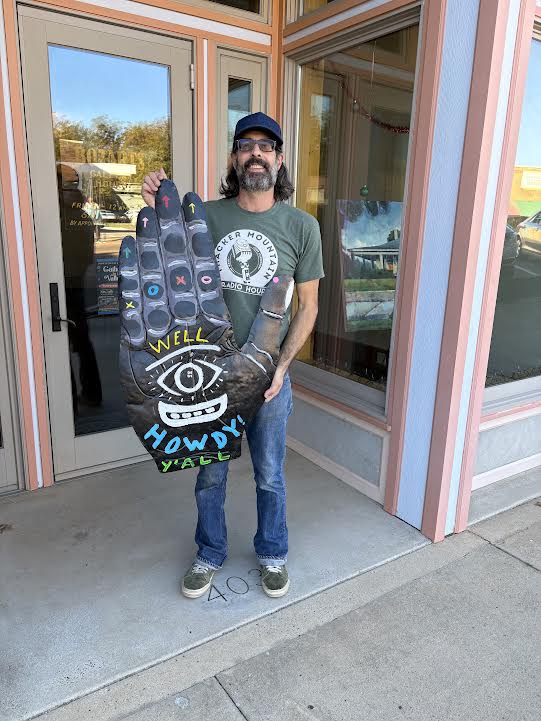
Showah laments that some of the most memorable moments in Hill Country blues were never captured for posterity. “Some of the greatest records were never recorded, never made,” he said. “And that was those times when there was a moment happening that could only be at that moment in that place and time with the people that were playing.”
He recalled one performance during a heavy storm when a musician stopped playing, dug a trench to redirect the rainwater and then led the band in a procession across the makeshift stream, turning the interruption into part of the show. At another gathering at the VFW in Holly Springs, musicians George Scales and Joe Ayers launched into an improvised, psychedelic jam that Showah described as almost mind-altering. Both moments, he said, would have been worth recording.
But the communal spirit behind those performances remains alive. Showah pointed to a May benefit he organized at his venue for Kenny Kimbrough, whose house had burned down. Musicians including Kenny Brown, Gary Burnside and Eric Deaton performed, while community members contributed food, time and money. The event brought together seven or eight performers and raised nearly $20,000, Showah said, demonstrating the communal values of the broader Hill Country community.
Building a home for music and community
For Showah, Voyager’s Rest, his live music venue in Water Valley, Mississippi, is about community, friendship, family, food and music rather than profit. After years of playing professionally, Showah said it is a blessing to own a music venue with a restaurant, the Crawdad Hole, right next door.
While the Crawdad Hole opened in 2011, Showah launched Voyager’s Rest in 2023. The venue hosts roughly 20 to 25 shows annually, featuring an eclectic mix of singer-songwriters, rock, soul and blues. With a capacity of just 50 to 60 people, Showah described it as something like a large house party, where musicians and audiences can connect in an intimate setting.
The inspiration came from Showah’s friend Ron Shapiro, who owned the Hoka Theater in Oxford, a bohemian theater and café that hosted all types of music.
“It was a freak zone. All walks of life were welcome,” Showah said. “All people were welcome there, and all kinds of music.”
Like Shapiro before him, Showah promotes an eclectic mix of music at Voyager’s Rest. Recent performers include the rockabilly blues act Heartbreak Kill, the blues trio Casual Jew and the improvisational duo Mike Baguetta and Eli Winter.
Showah pointed to a recent performance by Memphis band Heartbreak Kill, featuring Brooklyn guitarist Brian Hurd, as an example of what makes the venue special. Hurd delivered what Showah described as an almost otherworldly performance, seemingly losing himself in the music and connecting with everyone in the room.
The Crawdad Hole specializes in Cajun-style seafood, primarily crawfish and shrimp, while Voyager’s Rest offers rotating guest-chef dinners often tied to the backgrounds of the musicians and community members involved. Senegalese musician Guelel Kumba, for example, has prepared maafe, a traditional West African stew, while Eric Deaton’s wife has hosted Indian food nights. Other events have featured barbecue, gumbo and red beans and rice. Paired with live performances, the dinners give musicians an opportunity to share their culinary traditions alongside their music.
Showah hopes to put together a festival at Voyager’s Rest for spring 2027.