


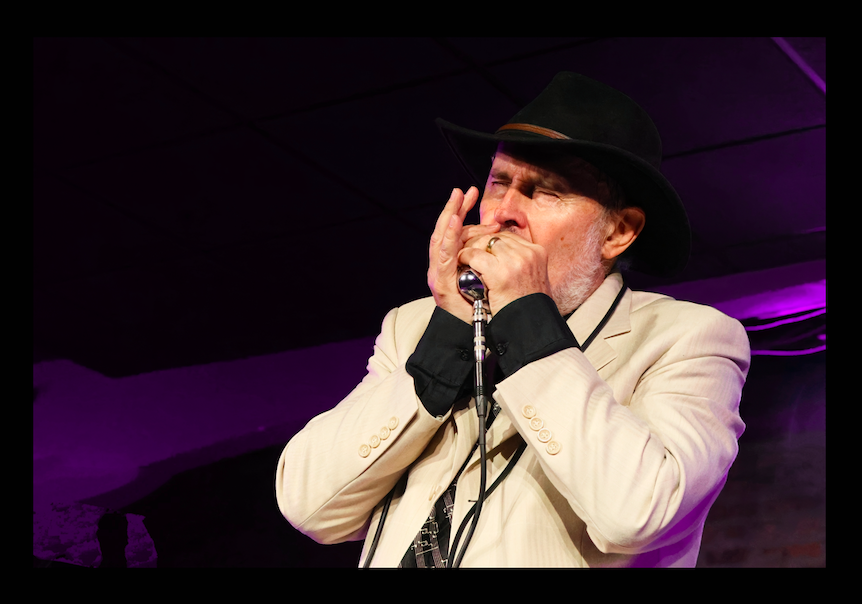
Pierre Lacocque’s name and accent telegraph the biography of a man very different from the artists he plays with. In some ways he is the most unlikely Chicago Blues bandleader imaginable. He was born in Belgium, has lived in France and has a Ph. D in philosophy.
On the other hand, his band Mississippi Heat has been on Delmark Records for 20 years, and has recorded eight albums for the Chicago label that’s been home to more indigenous Windy City groups than labels many times its size.
If you believe the principal requirement of any Chicago bluesman is a personal history of paying dues to own the blues, Pierre Lacocque stands tall with Junior Wells as one of Chicago’s premiere harp players. For him, the blues has always been about connection—across histories, cultures, and musicians. On the latest album Don’t Look Back, Mississippi Heat brings that vision to life, with Lacocque’s harmonica and Sheryl Youngblood’s commanding voice guiding listeners through a Chicago blues tradition.
The parallels between your life and my life are striking, and I’ve never talked to anybody that I’ve felt that much of a parallel with.
Nice. Tell me about it.
I’m the only child of a father who had a Ph. D in mechanical engineering, and I never thought I’d be writing about blues music. I thought I was going to go into advertising. I went to college at Tufts University from ’62 to ’66. And my suite mates were Bill Nowlin and Ken Irwin, and then I got stuck in the Army. I got activated as an Army Reserve unit, and when I went overseas to Vietnam I was in Long Binh Army Headquarters and I started writing about blues for The Army Reporter, and I never looked back.
Wow!
I had day jobs. I worked in advertising for General Electric ’cause you don’t make any money doing what I do.
Yeah. I understand!
How does having a Ph. D help you or hinder you in being a creative force in a blues band?
Hopefully helpful. I mean there’s no cultural meeting between the two worlds whatsoever because somewhat the same thing is expressed differently. It’s about life. It’s about the soul. It’s about suffering. So, actually, I don’t know what God had in mind, but it’s following God’s plan – but making a decision. It’s very helpful because I can deal with a variety of temperaments.
I tend to get along with people so that knowledge – temperaments, psychology, issues – helps a lot, but I would say there’s a lot of commonality between music and psychology. No conflict jumping from one to the other because its natural, and of course writing songs helped me a lot because I listen to everybody’s stories. I heard all kinds of stories that I can use to fashion songwriting.
When someone has the blues, by generic definition, they’re assumed to be sad. But bands know the opposite. How do you reconcile this dichotomy as a songwriter and a harp player?
So you’re saying blues is connected to a sad connotation but not from fans?
No, I’m saying that’s a misconception that people who don’t know much about blues have.
Yes. That’s correct.
Yes, some blues is very sad, but by what it does for the soul is the extreme opposite of that. I want you to say it. I don’t want to say it. Tell me in your words.
To me blues is about life, and that music is the most understood. So, it has a healing element for me as well. Whether it’s sad or not, it’s my life. It’s about being human. Of course, the roots of the music came from slavery times. It’s sad, unfortunately disgusting times, and yet it’s about life as well: uptempo joy and love. So it’s very understood, refreshing. It’s a puzzle, but a positive one. I tend to be religious; Not extreme but by God, what a wonderful shift in my life to be able to do this – because it’s all home.
Your father was very religious. What impact did that have with you? I read between the lines that your immediate family was not that enamored with you going in that direction.
Well, you know, it’s very interesting because my family had different periods with me when it comes to music. Later in life they were fully fully into it, fans and having been paid – actually, you know my childhood was very severe. We’re from Belgium. We traveled a lot to different countries, but our roots are very Belgian on both sides of the family forever. So, the culture in Belgium in my youth in my home was very severe, very not into playing, not just in music but being kids. You get to be little adults, It was very hard.
I feel a parallel with you in that regard. My father being a Ph. D in mechanical engineering grew up pretty much on his own, and his younger brother was quite a bit younger. He was listening to opera, and I was listening to rock and roll and blues. And it just consumed me. Then, I hung out with Bill Nowlin and Ken Irwin. That was it. Then I got activated in the Army, and I was able to write about blues in the Army Reporter. I turned a horrible situation into a lifelong occupation.
Wonderful. For me – first of all, my father had two Ph. Ds. He was one of these guys. He was a Biblical scholar, Old Testament, professor, writing books up the wazoo, world recognized in his field. Old Testament. His father also was very serious in terms of his intellect. And you know, culture was pretty rigid when it comes to behaving socially.
So, it was rough, man. But I was listening to radio in secret: Aretha Franklin, Ray Charles. I loved Otis Redding, and I liked some of the gospel. Clara Ward was a joy. Of course, Ella Fitzgerald, and my father at times would sit with us and listen to Clifton Chenier. He was more study, study, grow up to be a man quickly. Stay serious.
So, what was his attitude toward you going in that direction full time? Did he live long enough to see you grow very successful in his field: What was his reaction to you?
We came to Chicago in 1969. We immigrated to Chicago and it was pretty rough. My parents didn’t have much money. We were very poor in spite of his accolades, but teaching in universities. All of that stuff. So, when we came to Chicago my father’s income in particular was way better; I think he relaxed and his colleagues were quite supportive more than in Europe of his research, of his knowledge.
I know for a fact he calmed down. In my teens and early 20s, my father literally changed and became softer and welcoming, and he never complained when I was rehearsing harmonica, and I was awful. It was like a bad violin, you know when you start playing. He never complained. So, it kind of felt like he knew it was a soul thing for me. I feel it. It’s not an intellectual pursuit.
So, when I play, I close my eyes. I open my eyes to look at the audience, because I’m enjoying the moment. I’m focusing on the stage and all that, but I feel it’s the instrument that really inspires me. I feel my father may have seen that, as well as my siblings and my mother.
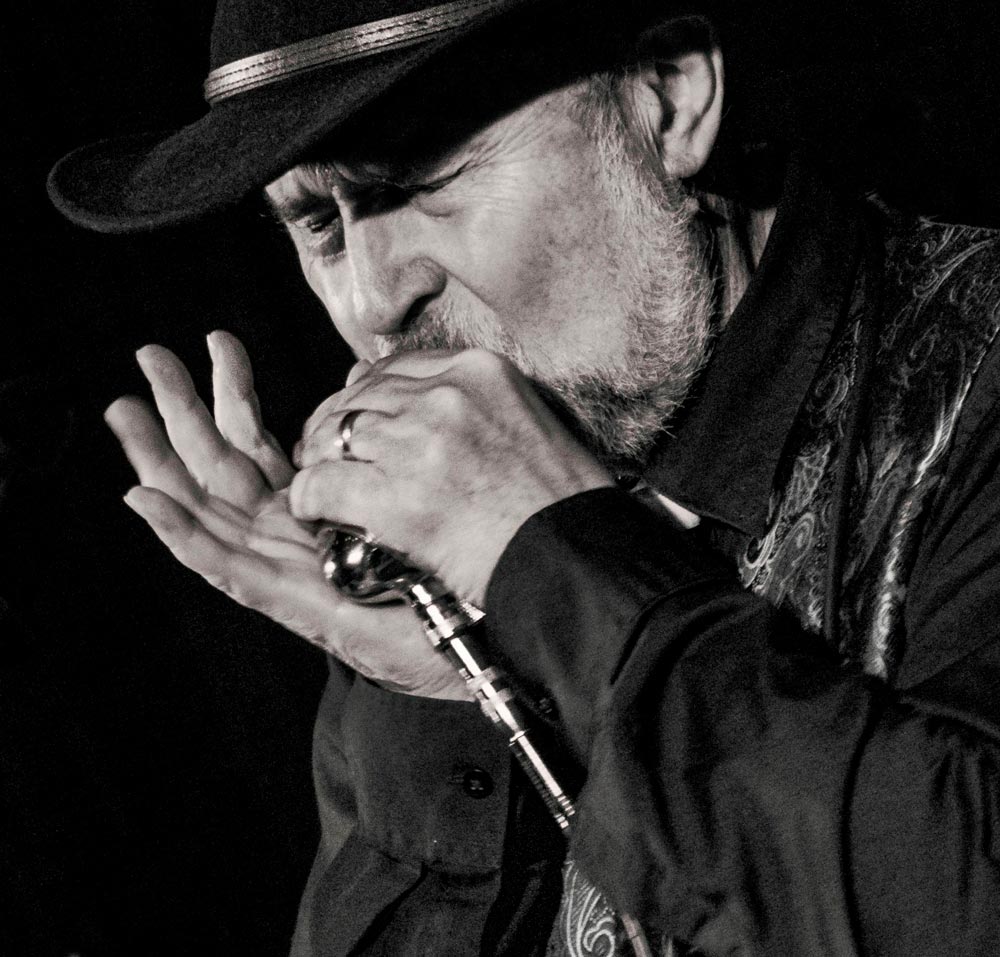
They say you have to pay your dues to sing the blues. But when I look at your background, you had an uncle that died in a concentration camp and a grandfather that was tortured by the Nazis. How has that background influenced you? How do you relate to all these great Chicago blues artists that you play with?
Don’t worry, Don. I think that’s an excellent question. In fact, it’s a question I ask myself. What is amazingly touching to me. I have a French accent as you can hear. I come from a different continent, a different culture, and that’s highly welcomed by the African-American community here in Chicago since day one. People like Paul Butterfield would have said the same. I feel welcomed to this day.
But as a child I was heavy-set. I was a sad child, and in the very beginning my father brought me—interestingly enough while we were living in France, where he was a minister and we were Christians with a parish in the mountains in Alsace. I was two and a half when he gave me a harp for Christmas. It was plastic, and I remember blowing it and crying—really sobbing—at the sound of the harmonica.I knew it was my destiny somehow. I had never heard blues. I was 16 and a half when I came to Chicago, but he was always in me—not that I can compare histories, but you know.
The depression seemed to be familiar in years in my early 20s. So the experience, the pain of isolation was in me for a long, long time. Europe, the world wars—there were two of them. The second one, with my uncle dying and my grandfather being tortured more than once because he was part of the Resistance. French people snitched on him because his area was invaded by the Nazis.
Was he alive long enough for you to get to know him?
Yes. My grandmother and my uncles as well; I was surrounded with stories like that. But also strangely enough, because of the extent of what I did with my sister and my brother, we went to a Jewish Orthodox school because of the Holocaust.My parents, my father, and his father were ministers as well. He had convinced the Jewish community. I don’t know how they did it. They did it. They they convinced the Orthodox school to take the non-Jews into their school years, and I started at four or five years old.
My father and my grandfather convinced the rabbis to take us in because they wanted us to be exposed to the survivors, you know. So, Holocaust, suffering, the torturing there was very much a part of my growing up.
How does that relate to your association with all of these great African-American artists and Delmark Records, and that whole society? What’s the common ground and where are you farthest apart?
The common ground is compassion. The common ground is definitely you know? We lived in many different cultures. We lived in many different countries, not only Belgium, but we lived in Israel, too. We lived in France. We lived in Germany, in Canada. We are part of the community; it was always an integrative way of looking at the meaning of our lives.
I intrinsically understand that because imagine my background having a father with a Ph. D. My mother had a teaching degree and I had a four-year degree in English literature from Tufts University, and he wanted me to go on and get a Ph. D. I said I want to work for a living, and I want to write about blues. I had a job in advertising. I worked days at GE. I was publications director for General Electric. Talk to me about 1969 and was there an ah-ha moment?
That’s my life, completely. In the summer of 1969 my father had received a full-time tenure, a chief position at the Chicago Theological seminary to teach Old Testament. He also founded the Judeo Christian Center over there. So, we moved over to Hyde Park in Chicago at the University of Chicago campus. So, one month in August I was alone and I was walking on campus. I heard a sound a few blocks away that I had never heard in my life. What is that? It was like a trance for me.
I kept following that sound. It was some sort of social event. So, they let me in. There was a quartet playing and four American workers and one of them with a harmonica. They were playing to a Latin fire. It sounded very warm – the tone to tonality. I hate to use the word religious (experience), but my life changed instantly listening to this harmonica player which happened to be the older Walter Horton. Of course, I’d never heard of him before, and I didn’t know what music he was playing. I remember one called “La Cucaracha” because everybody knows that melody and Big Walter was famous for that particular song. He recorded it a few times live.
Anyway, it was Saturday or Sunday because the store was closed. So, I go on Monday to Harper Court and I buy my first harmonica. Then, I became obsessed with spending hours trying to figure out – how do you make these sounds?
“In the Windy City, I found happiness and an unexpected welcome that remains to this day. Not only welcome by Americans of every cultural backgrounds imaginable but by the blues community in particular.” – Pierre Lacocque on writing this track
You didn’t have anyone to teach you?
No, I never had a teacher, but I did ask questions. And part of my father’s teaching position, the seminary paid for our school. I went to that school which was part of the University of Chicago, their high school, their lab school. Paul Butterfield went there years before me, which I did not know.
Did you ever compare notes with Paul Butterfield?
Never. I never met him. I would have loved to.
He came to Tufts University my senior year and played and that’s where I first saw him and I was at Club 47 in Harvard Square and got to see Howlin’ Wolf and Muddy Waters and the greats while I was still in college.
Yeah, Muddy Waters, Paul Oscher, Jerry Portnoy – I never met my masters. Little Walter is my master. Paul Butterfield, I would have loved to meet him. We went to the same school, but he was 10 years older. He traveled a lot. I enjoyed him and his band. I did meet James Cotton and Carey Bell. Jr. Wells is the one I got to know the best.
I wrote Buddy Guy’s authorized biography. So, I knew Jr. Wells pretty well.
What?!
Yeah, in 1991 I wrote Damn Right I’ve Got the Blues.
In the end, nothing about Pierre Lacocque seemed unlikely at all — just a man who followed the sound that first moved him and never let go.
