


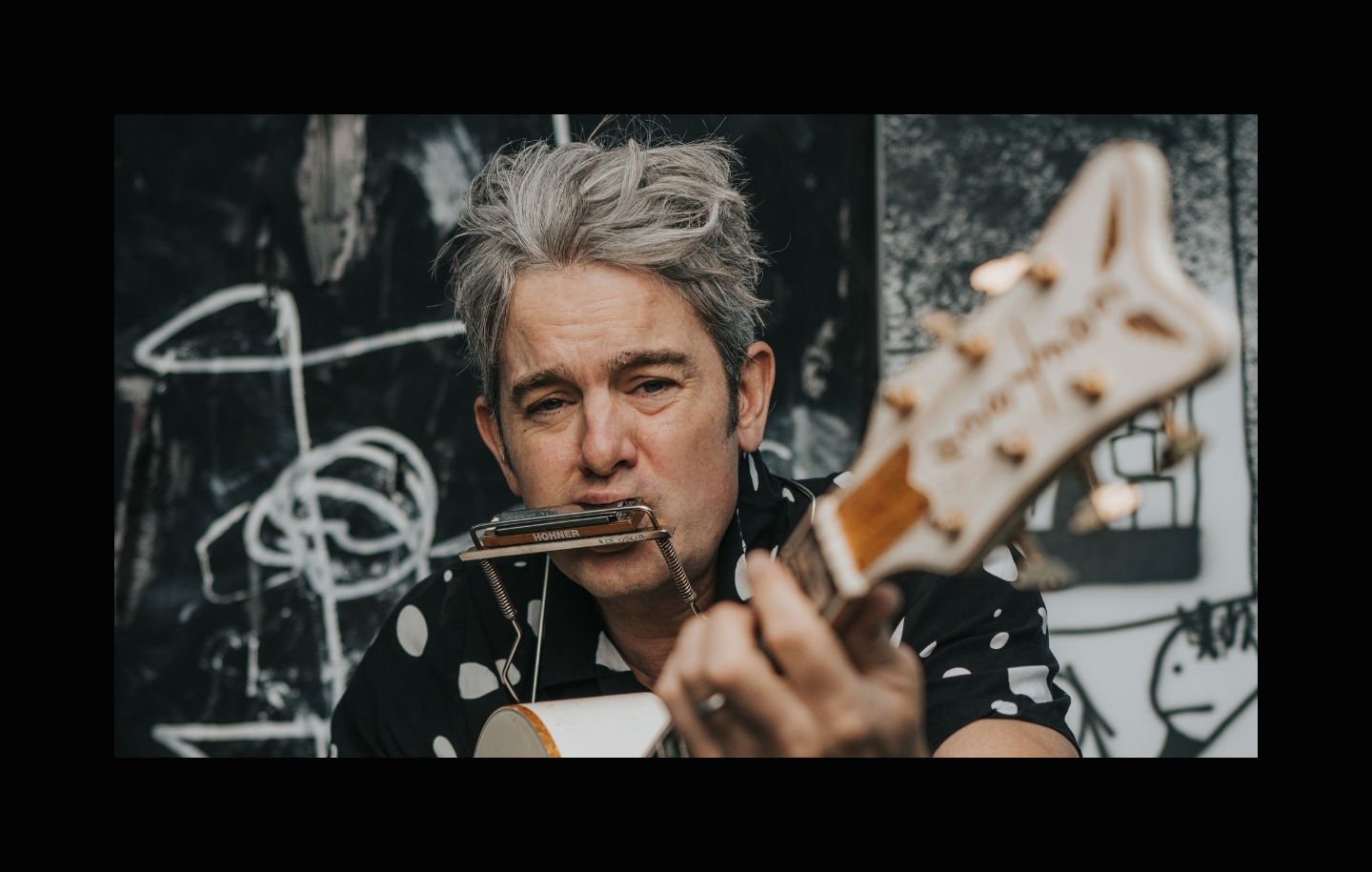
Before the beats, before the grooves, before the genre-blending cool of G. Love & Special Sauce, there was a harmonica. To Garrett Dutton—better known as G. Love—the mouth harp isn’t just an instrument; it’s a primordial voice, a powerful emotional outlet.
“I wasn’t the best singer and I wasn’t the best guitar player,” he admits. “But once I added the harmonica, it all worked.” That simple realization helped transform a street busker into G. Love, a musician who would go on to carve out a singular sound, blending blues, hip-hop, and rock in ways that seemed both effortless and entirely unique. His early influences were wide-ranging: Bob Dylan, The Beatles, Chuck Berry, and Lou Reed, before he drifted into a love of hip-hop and the blues.
“I was doing an acoustic kind of folk-rock thing,” Love said. “When I was 15, I started playing harmonica on the rack. And that was when Bob Dylan became even more important. Being in the ’80s as a high school kid, I thought I was the only person in the world who had ever heard of Dylan. But when I started playing open-mic nights, I realized a lot of people were inspired by him.”
Around the same time, Love’s musically attuned friends “turned [him] on to anybody who plays acoustic guitar and harmonica, solo acoustic,” he said. When he was given a John Hammond country blues record, “that was a road map back to the blues, because he was doing renditions of everybody’s songs. I was learning Robert Johnson songs, Howlin’ Wolf songs, Jimmy Reed, and Lightnin’ Hopkins. It took me on a journey.”
Growing up in Center City, Philadelphia, Love also fell in love with ’80s hip-hop, which he calls the “golden age.” He tuned into Street Beat with Lady B on Power 99 FM on Friday nights, listening to Public Enemy, Eric B & Rakim, KRS-One, and Boogie Down Productions.
“Hip-hop music was what we were listening to as a culture,” Love said. “We were skateboarding, graffiti writing, and there was a Grateful Dead kind of vibe, because people were smoking pot and jamming out. So this whole inner-city high school party scene emerged that was hip-hop and the Grateful Dead.”
Despite their stylistic differences, Love naturally blended the rap he heard with the blues records that inspired him. “It just kind of happened,” he said. “I was having a great night, feeling loose, and I just started rapping an Eric B. & Rakim song called “Paid in Full” over my blues riff. That was when I knew I came upon something no one else was doing, and I had a very clear feeling that, wow, I really figured it out.”
Dutton formed G. Love & Special Sauce in the mid-’90s, producing albums like G. Love & Special Sauce, Coast to Coast Motel, and Yeah, It’s That Easy. The band carved out a singular sound—a loose, streetwise hybrid of hip-hop cadences, front-porch blues, and laid-back rock that never quite fit any genre but somehow felt completely natural. The core lineup included Dutton on guitar, vocals, and harmonica; Jeffrey “Houseman” Clemens on drums; and Jim “Jimi Jazz” Prescott on upright bass.
“Originally, I called myself Crazy G and then Foot Stop at Street Side Blues of Garrett Dutton,” Love said. “And then when I met the band, I wanted to call the band Special Sauce, but the drummer said, ‘No, it’s gotta be G. Love and something.’ So I said, ‘Great, G. Love & Special Sauce.’ And that was that.”
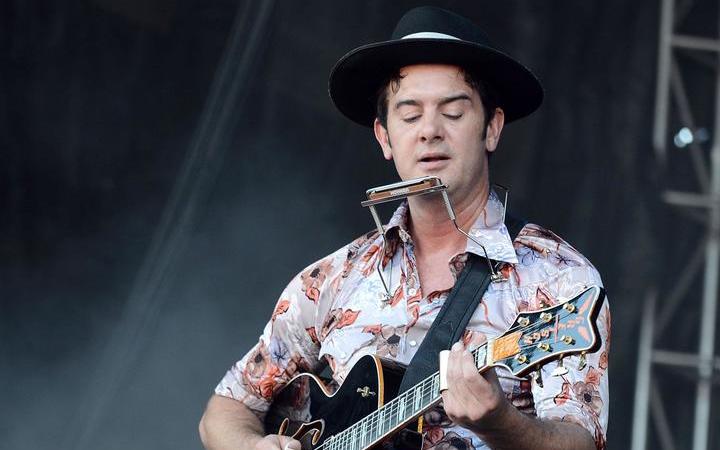
Blending blues and hip-hop has not always been met with universal praise. “Hardcore blues aficionados or hardcore hip-hop aficionados don’t care to understand what we’re doing,” Love said. “By nature, those people are maximalist about the style they love. What we’re doing is a crossover. It’s a mashup. So I think it’s hard for some people to relate to that.”
Yet the unique creation also draws in new audiences. “Someone will say, ‘I never liked rap music, but I like what you do.’ Or some people will say, ‘I don’t really like blues, but I like what you do.’”
In 2022, Love organized a group of Mississippi bluesmen to create a hip-hop blues record, Philadelphia Mississippi, leaning heavily into both genres and produced by Luther Dickinson. Musicians featured included Alvin Youngblood Hart, Christone “Kingfish” Ingram, R.L. Boyce, Trenton Ayers, Jontavious Willis, Tikyra Jackson, and Sharde Thomas. The album was recorded over five days in a studio.
“It ended up being kind of a hill country summit, just a blues summit,” Love said. “We got a gig with the Allman Betts Band and Cedric Burnside playing in Jackson, Mississippi. We were playing in people’s backyard barbecues to get us down there.”
In the early ’90s, Love recalls that European journalists fixated on the fact that he was a white Philadelphian blending rap and blues—while in the U.S., almost no one brought it up. What mattered more to him was hip-hop’s cultural context. Even though the music had already been embraced by an entire generation across racial lines, he says it was still very much rooted in Black culture—created inside it and speaking from it—and it took years before the rest of the industry absorbed its production style wholesale.
“It was still culturally Black music made by Black people, right about their culture,” Love said. “The older cats, like anybody from Tribe Called Quest, or on both sides of the musical spectrum there—blues and rap—everybody was always supportive and intrigued by what I was doing. It felt like an honor when Q-Tip would say, ‘Yo man, I’m a fan.’ Keb’ Mo’ used to call me an American original.”
G. Love & Special Sauce’s core fanbase has always existed at the intersection of college-radio kids, jam-band travelers, surfers and skaters, and roots-music listeners who also loved hip-hop. “In a broader scheme, I really do roots music,” Love said. “And, you know, I’ve always considered myself a bluesman before I consider myself an MC. So it’s almost like I’m a rabid bluesman.”
For Love, both hip-hop and the blues draw their power from the lived reality of Black America. “The music is for the culture—for the experience of African American life in this country,” he said. “That’s why the writing is so poignant. Like the blues, it’s talking about real things happening to their people, in their neighborhoods, as they move through the world. It’s political, social, economic—it’s present, and it’s real.”
The blues, he said, has always been about discovering individual voices. He remembers “taking a journey with so many different blues men” through records by Lightnin’ Hopkins, Big Bill Broonzy, Mississippi John Hurt, Mississippi Fred McDowell—and especially John Lee Hooker. Hooker drew him in with what Dutton calls “on-the-one blues,” music that sits in one place and suggests movement without always following the rules.
“He would imply the chord change—or not,” Dutton said. “That looseness felt thrilling.” What fascinated him was how emotion didn’t rely on elaborate chords but came straight from delivery. “If you wanted to make this feeling emote, you had to do it with your voice or the lyrics.” Hill country blues, in particular, showed him that the form could float: “It doesn’t always have to be a 1-4-5, 12-bar form… it skips bars and it doesn’t hold the form.” That freedom—imperfect and hypnotic—is what keeps pulling him back. “I like to do something different than what everybody else is doing,” he said.
Though G. Love’s music can sound loose and easygoing, he bristles at the idea that it’s simple. Beneath the grooves are subtle choices, unexpected turns, and a feel that’s harder to copy than it seems. He’s most proud of carving out his own lane, building a musical niche that has evolved into its own genre over the course of his career. Part of that work is deeply studious: he combs through the blues canon, borrowing riffs and phrases and reshaping them into something distinctly his. He can trace a lick back to Muddy Waters or Robert Johnson if pressed. “We wear our influences on our sleeve,” he said, “but the end result is my own.”
Many people misunderstand his blend of blues and hip-hop, reducing it to a simple groove. What sounds effortless often hides subtle layers. Love is also proud to influence a wide variety of artists across the musical spectrum. Jack White has performed Love’s Garbage Man, and clips of Dan Auerbach appear online with G. Love covers. Jack Johnson and Slightly Stoopid cite him as a key influence.
“I got to sit with John Lee Hooker. I got to become family friends with John Hammond,” Love said. “I got to tour with Tribe Called Quest, Run DMC, Gang Starr, and Cypress Hill. I got to become friends with a lot of my idols, and I got to see people I influence become some of the biggest musicians in the world.”
Love keeps his purpose modest and direct: he wants the music to lift people up. His mission is “to get out there and make people happy—and make people feel inspired.” In 2019, his album The Juice, produced and co-written by Keb’ Mo’, earned a Grammy nomination for Best Contemporary Blues Album. Moving forward, Love hopes to win a Grammy. Additionally, he aspires to be invited into the Rock and Roll Hall of Fame. Aside from these ambitions, he said he “just wants to make great records.”
Decades into his career, Love is as confident as ever, saying that Ode to RL (2025) “is one of my best records I’ve ever put out.” The album, an homage to Hill Country Blues great R.L. Boyce, dives into the grooves and rhythms of Northern Mississippi. In many ways, Love’s blend of blues and hip-hop carries Burnside’s spirit forward: raw, rhythmic, and always rooted in the trance of the “on-the-one” groove.
Love says Ode to RL captures some of the best harmonica playing of his career. The project grew out of live sessions in Philadelphia, Mississippi, later “chopped up and made into hip-hop beats,” he explained. The album keeps a unified sonic palette: RL Boyce’s voice and guitar, Luther Dickinson on slide and Wurlitzer, Chuck Treece handling drums and bass, and Love’s harmonica layered over the top. “It’s a very good sound and tone,” he said—cohesive from start to finish, with the exception of one track where he switches to electric harp.
According to Love, much of his best harmonica playing has come out and developed in the past 10 years, and he is confident in his abilities as a harp-blower.
“I learned how to play less to make more space, and the technique became better. The authenticity. It becomes more real. The confidence level is there,” Love said. “I feel like I could go on stage and play harmonica with anybody in the whole world, you know, as long as they’re playing something that was in the right key, and it wasn’t too jazzy with some stuff you just can’t do. I can go out and wail a good solo on just about anything.”
Over a multi-decade career, Love has had some wild times on tour—like taking acid in the ’90s and ending up in New Orleans on the riverfront at dawn. After getting married in 2019 and starting a family, Love weighs settling down more, with fewer tour dates. He said he wants to play bigger shows.
“Is it just the thing that musicians tour till we die?” Love asked. “Or do you actually retire and chill out and be with the people that you love?”
In terms of songwriting, Love constantly writes down ideas, which he later develops on a guitar in quiet spaces. More recently, with producer Logan Tichnor, he has been attempting to write in the studio “while the mics are hot,” a “nice departure from traditional songwriting,” beginning with their work on Ode to RL.
As a skilled harmonica player, Love is often enlisted to play on other musicians’ albums. Love said his prowess on the harmonica compensates for a lack of incredible guitar technique or outstanding vocals. “The harmonica is very immediate—almost primordial—and incredibly expressive,” he said. “I’m not really a great guitar player, and I’m not really a great singer. I’m a pretty good harmonica player. But the three of them together—that kind of works.”
G. Love reflects on the bond with his bandmates, especially in the wake of the pandemic. The band formed in 1992, with a relatively consistent lineup over the years.
“We really have a strong brotherhood after COVID,” he said. Drummer Jeff Clemens decided not to return to touring, though the trio managed three shows together in Europe this past summer. Clemens has retired from the road and is thriving in Nashville, doing session work with Dan Auerbach and contributing to projects like Hermanos Gutiérrez and Robert Finley’s records. “He’s very just over the moon about that,” G. Love noted.
Meanwhile, Jimi Jazz (Jim Prescott) remains with the band, and G. Love emphasizes the resilience and dedication they share. “We’ve been through some tough times, but it all ended up being a lot of love and brotherhood,” he said. “We dedicated a lot of our lives to making this music and creating this sound, and this certain thing that the three of us did, and I think we’re all very proud of that and thankful for it.”
During our interview, Love was driving with his wife, Kelsey, and their three sons over the winter holidays. Periodically, the kids shouted out in excitement, boredom, or laughter, and Love would patiently ask them to quiet down so the conversation could continue. Amid the chaos, a tenderness shone through—having a family has profoundly shifted Love’s perspective on life and music.
“It’s changed everything. It’s made my life complete, and it’s given me a reason to really try to be great—both musically and as a father,” Love said. “It’s the greatest gift ever. My family is the most important thing.”
