


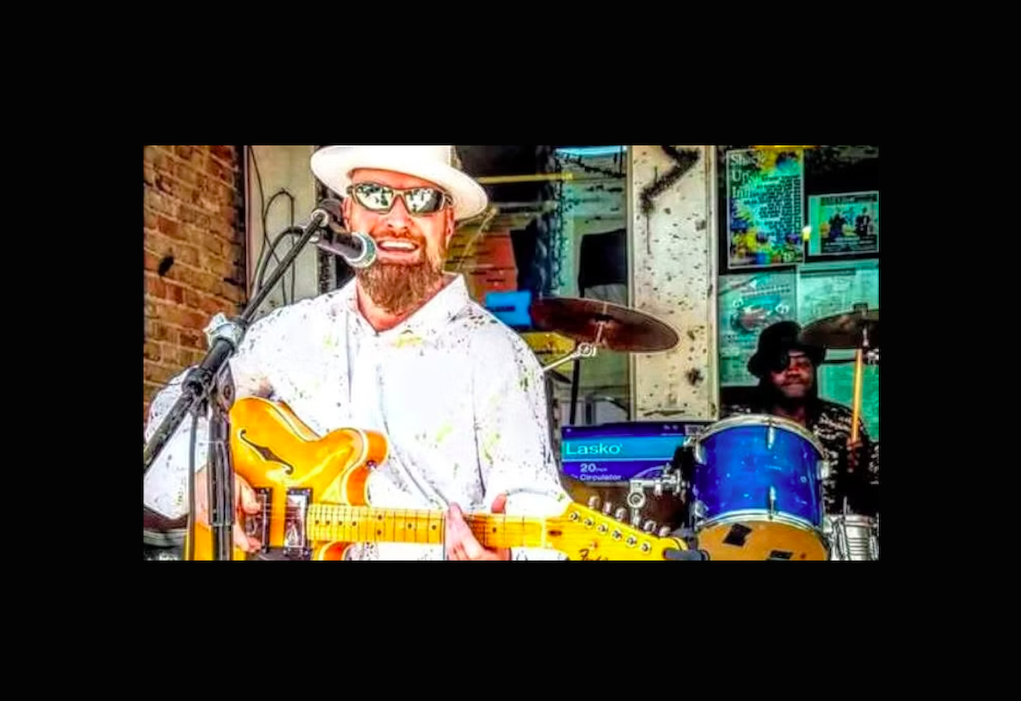
Sean “Bad” Apple recalled how the crowd reacted to Jimmy “Duck” Holmes performance at Bad Apple Blues Club seven years ago. “My place was packed. Not only was every seat taken, but every inch of floor space. People were sitting on the floor,” Apple said. “And he was going into this groove, and it felt like the whole building was just moving from side to side. He had them wrapped around his fingers, man. They were all locked in. It was beautiful. It’s the closest thing to heaven you can find on this earth.”
As music changes and generations inherit new flavors of sound, Apple, the owner of Bad Apple Blues Club, says all that musicians can do is honor our heroes. What comes out is not a replica of the original, but an authentic adaptation – something new, derived from a unique musical stew.
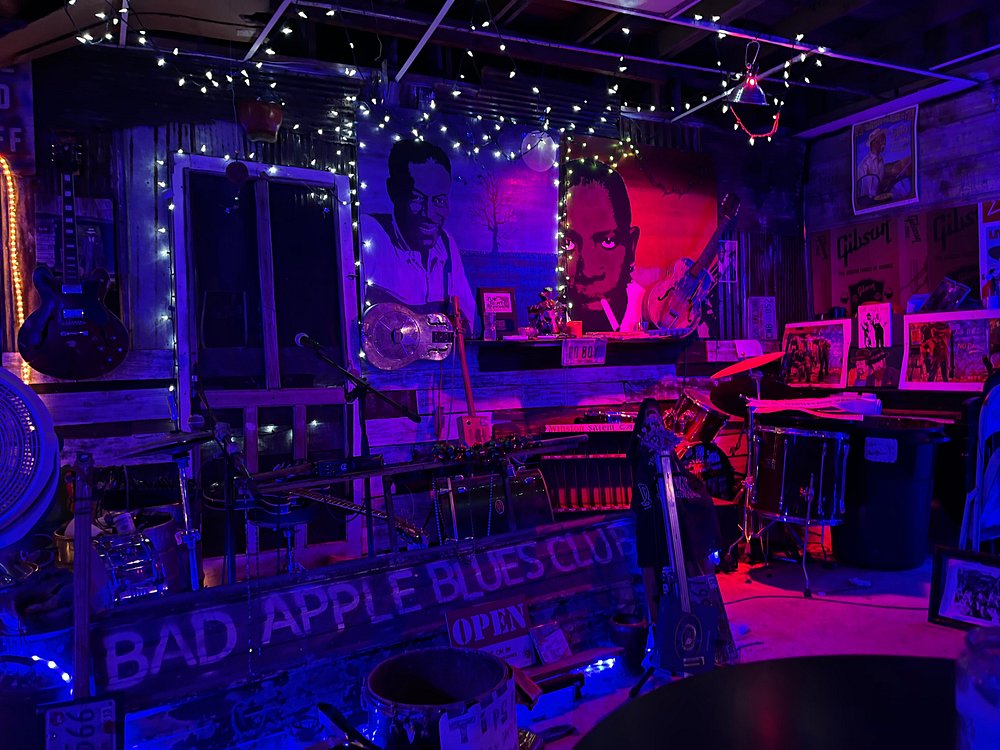
Apple grew up in Harvey’s Lake, Pennsylvania, a town few have heard of. The closest recognizable town, Scranton, 45 minutes away, became famous for the highly popular comedy The Office. Raised on the Allman Brothers, Lynyrd Skinnard, the Rolling Stones, Eric Clapton, and Jimi Hendrix, Apple soon found himself devouring the Blues Review Quarterly, reading articles on Howlin’ Wolf and Muddy Waters.
Picking up a Robert Johnson album at Joe Nardone’s Gallery of Sound was life-changing, Apple said. He began buying records by Son House, Charley Patton, and Blind Willie Johnson — any blues he could get his hands on. Yet something felt missing, Apple said. He wanted a tangible connection to the music and to explore the music of his blues heroes. In the 1990s, Apple made the leap, embarking on a road trip with a friend and loose plans to meet and learn from the Mississippi greats.
In Bentonia, Apple encountered guitarist Jack Owens and his harp player Bud Spires. Owens, then 88, was accessible and hospitable – he offered to let Apple sleep on his couch, to go fishing with him, and to sit in his yard or on his porch and play music as long as he wanted.
Apple moved around, travelling as far as California and Alaska, but kept coming back to Bentonia, where he would stay for months at a time. As he said, “Mississippi would call me back.”
In Bentonia, Apple learned from the older Black generation through an informal process. He said they were willing to share their knowledge, but nobody would sit down and instruct him on how to play a song in the traditional sense.
“Nobody I played with knew what any note was called on the guitar that I learned from. No one knew how to articulate or describe what they were doing,” Apple said. “They just did it, and you just had to spend time and kind of try to pick apart their style.”
Apple matched his strings to the open notes they played and worked to figure out what tuning they played in on the guitar. The blues community took him in, he said.
After playing the Bentonia style for some time, Apple traveled to Jackson and Clarksdale, Mississippi, where he was introduced to R.L. Boyce, from Como, Mississippi. Boyce introduced Apple to North Mississippi Hill Country blues, and the pair would play in Boyce’s yard every day for almost four years. Boyce’s family treated Apple like a nephew, he said.
At Apple’s club in Clarksdale, Mississippi, he plays a mix of the blues styles he has studied, taking audiences on a musical tour through the different regions of Mississippi. Naturally, he gravitates toward Hill Country blues, he said, but appreciates several styles.
“Bentonia’s a little more haunting and somber,” Apple said. “In the Hill Country, a lot of it just stays on the one chord and just kind of rides and rides till the wheels fall off, you know? And it’s just about the groove.”
Over the years, Apple has immersed himself in Hill Country culture and music. He said musicians who try to learn the music academically will never understand where the music comes from — “it’s different than playing in RL [Boyce’s] yard.” His experience has been built from playing at Po’ Monkey’s Lounge and countless yard parties and juke joints.
Fifteen to 20 years ago, Apple played in a Hill Country band with Calvin Jackson on drums, Joseph Burnside on guitar, and Martin “Big Boy” Grantz on harmonica. The group played across North Mississippi and at some festivals, with a characteristic Hill Country sound.
“It’s like drinking corn liquor and beating that juke joint all night and kind of trancing out,” Apple said. “It’s the trance music of the blues.”
For many people in the Hill Country, according to Apple, playing music is not a choice. Apple played for three years with Terry “Harmonica” Bean, who grew up with 26 brothers and sisters in a musical tradition. While Bean was an impressive athlete, able to throw over 90 miles per hour as a pitcher, he relied on music after he was injured in a motorcycle accident. Bean has started to do one-man-band music, which Apple said is a pure approach to the blues and reflects where Bean came from.
Aside from the music, Apple said that the Hill Country has its own culture. An essential part of that culture was juke joints, which served as a social sphere where people could unwind. Apple said that juke joint culture is, unfortunately, dying.
“For the Black population across Mississippi, music was the thing that was all-encompassing. Everyone partook because it was the only thing folks had to take their mind off of a very hard existence with no options, no opportunities, stuck within this system of cotton,” Apple said. “Music is magic, you know? It’s that special thing.”
Along with the music in the juke joints, Apple said, came gambling, dancing, joking and hanging out. He added that they couldn’t go to the spa or a psychiatrist, so the juke joint served as all-encompassing relaxation. It was about all kinds of community and social interaction.
Apple added that people sang songs in the fields to get through the day. When they returned home, everyone gathered together at the juke joint for music. Music was central to their lives.
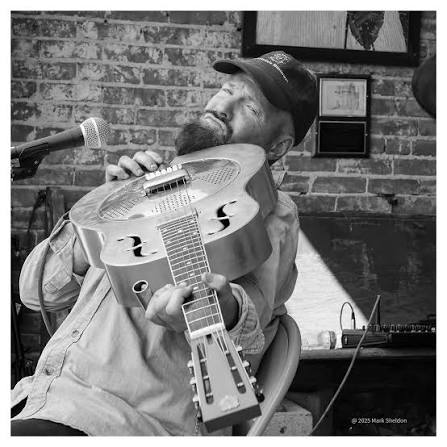
Yet today, juke joint culture is dying, Apple said. Willie Seaberry, who owned Po’ Monkey’s, passed away in 2016. Several other clubs have closed. The audience has shifted from mostly Black to mostly white. Apple sometimes has to encourage people to enter the club because it looks too gritty for some of the newer patrons.
The live Hill Country experience remains incredible, Apple said.
“There’s nothing like it. It’s the ultimate connection. Conversation is nice. Jokes are nice,” Apple said. “All the Black juke joints that I came up playing in as a teenager when I came down here, it wasn’t solely just about the music. It was all about the fun and conversation and jokes.”
As a club owner, Apple said it’s rewarding when someone comes with a life dream of visiting Clarksdale and seeing authentic blues, telling him, “you really got to the heart of it, and you took what I learned from the Delta Blues Museum, and you put it in a package with demonstrations, and you tied it all together.” Yet sometimes people don’t come for weeks at a time as bills stack up.
While he tries not to worry about the money, Apple noted that he could make more money at Burger King making onion rings. With little income, Apple has been unable to see a doctor or afford health insurance.
“I got into this music because I’m passionate about it. I love it more than anything,” Apple said. “But when it’s not a reciprocal relationship, it just gets harder and harder and harder.”
Apple said the material conditions in Mississippi have not improved over the years, and if anything, have gotten worse. The state remains “extremely poor.” Apple said he only brought in $14,000 in total earnings from his Clarksdale club.
The extreme hard times influenced the music — it came out of the cotton fields, juke joints and churches, and went on to shape the world’s music, giving birth to rock and roll. Apple said there would be no Led Zeppelin, no Jimi Hendrix, no Rolling Stones and no Allman Brothers had it not been for the blues traditions formed in poverty.
Apple added that the audience for “actual, authentic, old-style blues” is very limited. He added that while some people’s broad definitions of the blues may include the Blues Brothers or Whitney Houston, the older white crowd that visits Bad Apple Blues Club comes to see the type of blues performed by B.B. King, Howlin’ Wolf and Muddy Waters.
Authenticity is important to Apple. According to him, many people who book venues these days are unqualified and end up hiring their friends or putting on ’80s rock or country music nights. As blues clubs change hands, the music risks declining.
When he first arrived in Mississippi, Apple developed a strong relationship with Jack Owens. Owens would show Apple off to the community, calling him his “grandson.” While the Black community had little knowledge of where Pennsylvania was, Apple said they couldn’t have cared if he was from the moon.
“It was like, ‘You’re a white man, a white kid who wants to spend time with me, an older Black man, and learn this music,’” Apple said. “It was definitely more of the older Black man happy that a young white dude wants to learn the culture and tradition, and me, a young white man, so happy that an older Black man would take time to spend time with me to show me behind the curtain of where this music came from.”
The community born and raised in the hills of Mississippi is protective of the Hill Country style of music, Apple said. Yet, naturally, it is changing with time. “Music is always changing. And that’s just human nature. As we start being musicians in any genre, your goal when you first start is to be like your heroes. You want to sound just like them and be like them,” Apple said. “As soon as you can play, it comes out in your own way, in your own life. You have a signature on how you play.”
Apple said he doesn’t lament that the genre is constantly changing; any time someone creates music, it’s a beautiful thing. While there’ll never be another R.L. Burnside or Junior Kimbrough, “all we can do is honor our heroes.”
The internet has made it easier for blues travelers to find their way to Mississippi’s music. Before social media and online event listings, he said, visitors often had to “stumble upon things.” Now, musicians and venues can coordinate, promote shows and connect with audiences from outside the state. But Apple said that wider reach has also come with a tradeoff: the Mississippi blues tradition feels increasingly diluted.
Older generations of musicians had often come directly from the cotton fields, carrying a firsthand connection to the culture and history of the region. Today, he said, even musicians like himself who move to Mississippi from elsewhere bring different backgrounds into a tradition that was once more distinctly rooted in the state.
“I wasn’t born into this culture. This was a choice I made,” Apple said. “To come and be part of this.”
Newer musicians who try to recreate the sounds of the past often struggle to achieve the same purity, Apple said, because they are inundated with a multitude of sonic influences. “Howlin’ Wolfe doing a song, you hear where his music came from, through his voice, through his story. It sounds like cotton fields and whiskey in an old shack in Mississippi,” Apple said. “The Rolling Stones doing the same exact song, Mick didn’t come from that. So his is going to be a little more probably identifiable with white audiences.”
Because the Rolling Stones were considered pop music during their peak, they, knowingly or unknowingly, turned a generation onto the blues, helping fuel the British Invasion. To fully understand Hill Country blues, Apple said that anyone must listen to R.L. Burnside, Junior Kimbrough, Robert Belfour, and T-Model Ford.
