


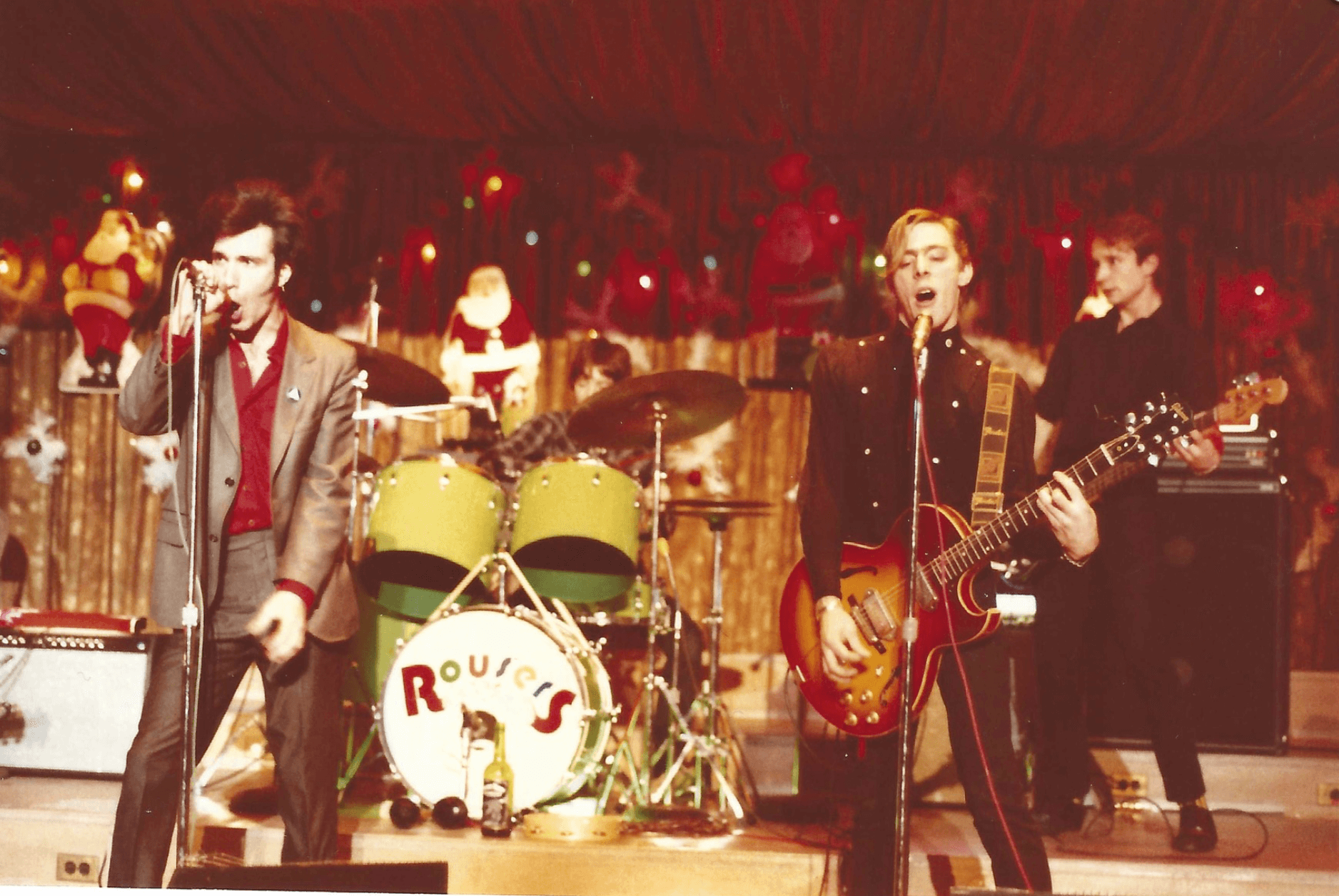
A group called the Rousers formed in New York in 1977. They were Jeff Buckland (vocals), Bill Dickson (rhythm guitar), John Hannah (bass), Tom Milmore (lead guitar) and Jerid O’Connell (drums). Their “Rhythm and Twang” sound found appeal among the city’s music scene and they developed quite a following. In 1979 they recorded an album for Sire Records. According to Dickson, the album was “packed with hits.”
It was an exciting time for Dickson and company. He and O’Connell had moved to New York City from Weston, CN to attend the School of Visual Arts (SVA). They were interested in the city’s rock music after having heard the New York Dolls play in Bridgeport in the early ‘70s. They had dabbled in songwriting for their high school bands and the idea that they could be part of the scene was irresistible.
The idea of recording an album was even more so. They arrived at Media Sound for the recording session full of excitement.
“We brought our gear in, set up, and basically ran our set—bam, bam, bam,” said Dickson. “I think most of it was recorded on a Saturday and mixed Sunday.
“You know, it’s thrilling to be asked to make a recording for a record company. It’s like, oh, step one, you know, that’s… But in my mind, it kind of came and went, you know. I mean, it’s something we did, okay, (but) what’s going to happen now?”
And nothing in particular happened. “Also ownership was, as far as I know, Sire owned it,” says Dickson. “I don’t think it dawned on us to out ourselves.”
Why Sire Records never released the session is not clear. What is clear is the tapes sat shelved in the Rock & Roll Hall of Fame’s Sire archives for decades before Jerid O’Connell discovered them. He also found a tape of a Rousers’ live performance recorded at Max’s Kansas City.
According to Dickson, “He (O’Connell) connected with Jim Reynolds of Left for Dead Records.” They agreed to transfer and digitize the Sire tapes to see what could be done.
Ed Stasium, who has worked with such legendary groups as the Ramones, Talking Heads, and Smithereens, and who produced the original recording, was approached about mixing the album. Ed was able to mix only one track.
“So we brought in Bob Stander (of Parchessi Studio),” Dickson told me. “He’s brilliant. I went to his studio in Huntington, and we worked through the mixes.”
The end result is a 13-track album on the Left For Dead label entitled Rousers 1979 Sire Session, out now on 12” LP and as a 2-CD set with bonus tracks. The full album will be coming to streaming services in 2026.
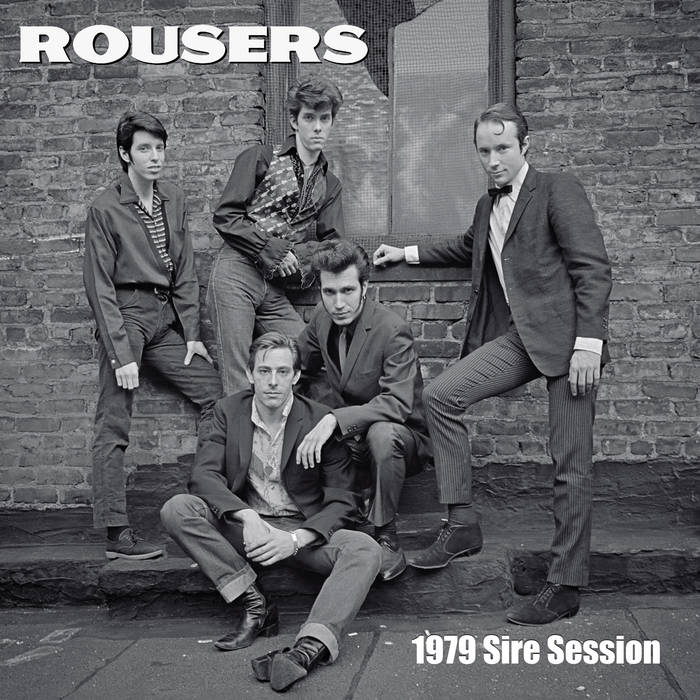
Dickson was being somewhat tongue-in-cheek when he said the album is full of hits. But then, that was the goal.
“We were trying to write hits,” he said. “We had varied tastes—sometimes you want to rock hard, sometimes you want to twang, sometimes you write a ballad. We just followed what interested us.”
The Sire Session songs do present a variety of sounds rooted in the 1950s and 1960s. Some songs show the twanging influence of Duane Eddy. “We took (our) name from Duane Eddy’s ‘Rebel Rouser,’ Dickson acknowledged. “Big fans – we covered him a lot.”
Some songs have a rockabilly influence not unlike the Stray Cats. Dickson agreed. “Some of our sound was what you’d call neo-rockabilly,” he said. “We loved that early rock-and-roll stuff and covered ‘Jeannie, Jeannie, Jeannie’ by Eddie Cochran, for example. By ’77–’79 we already had that twang. Then a rockabilly revival hit—Buzz & the Flyers, Levi & the Rockats, the Stray Cats, all that.”
Still other songs are straightforward rock and roll, which is only natural. “We were absorbing influences like everyone did. You grow up hearing the Beatles, Stones, Dave Clark Five—then you discover those were covers and suddenly you’re deep into Larry Williams, Carl Perkins, Buck Owens. Meanwhile T. Rex, Slade, and the Dolls are happening. Music was wild and exciting.”
So are there any favorites?
“I’ve always been very fond of “Twanged If I Do, Twanged If I Don’t,” Dickson allowed. “It’s a silly song I love. ‘Bumblebee Rock’ is almost cartoonish lyrically but rocks hard. ‘Party Boy’ was considered a signature tune.
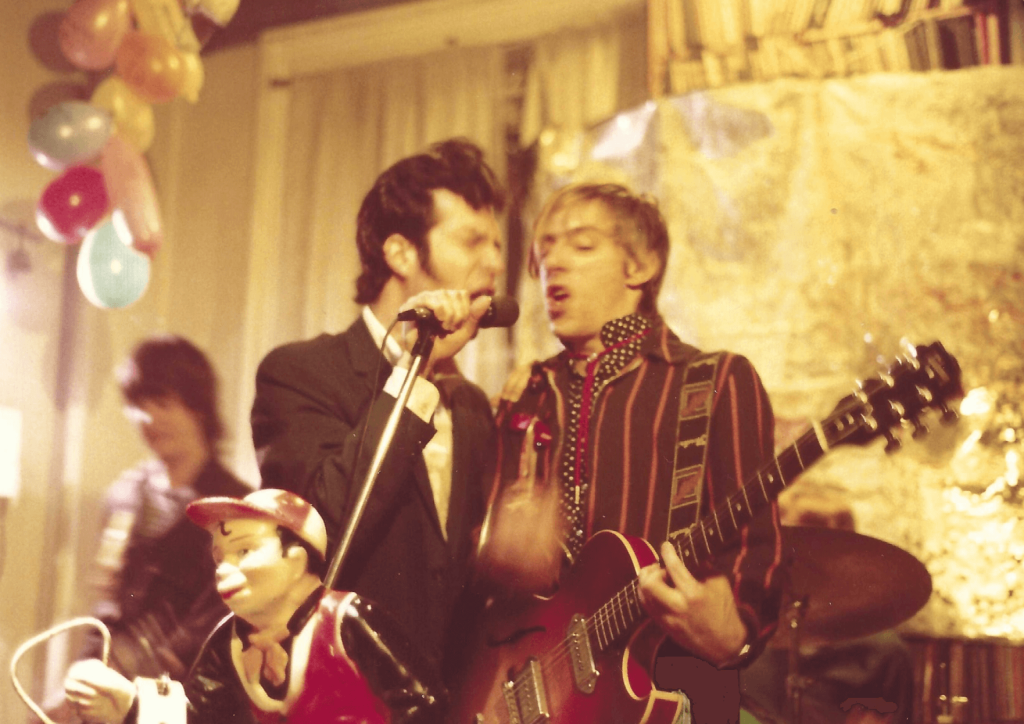
“To be honest with you, ‘Smother,’ to me, it’s an attempt at something. But it sounds like an ‘80s perfume commercial in retrospect. It’s like a pretty good but failed experiment in sounding that way. It sounds pretty and it’s kind of heartfelt, but I think ultimately the song is kind of syrupy.”
Covers of “Baby, It’s You,” “Pipeline,” and Solomon Burke’s “If You Need Me” are notable also.
“I love all those songs,” Dickson says. “They were fun to play, and still are. I hope listeners learn them and play them themselves. I hope people feel the same delight hearing it that we felt playing it. Maybe ‘joyful’ is overstating it, but we were making good music and having a great time. If you want to hear a band having fun—and you want to tap your toe—this album will do it.”
Listening to The Rousers 1979 Sire Session now, fun does seem like a core part of the band’s persona. As he predicted, my toes quickly joined in.
