


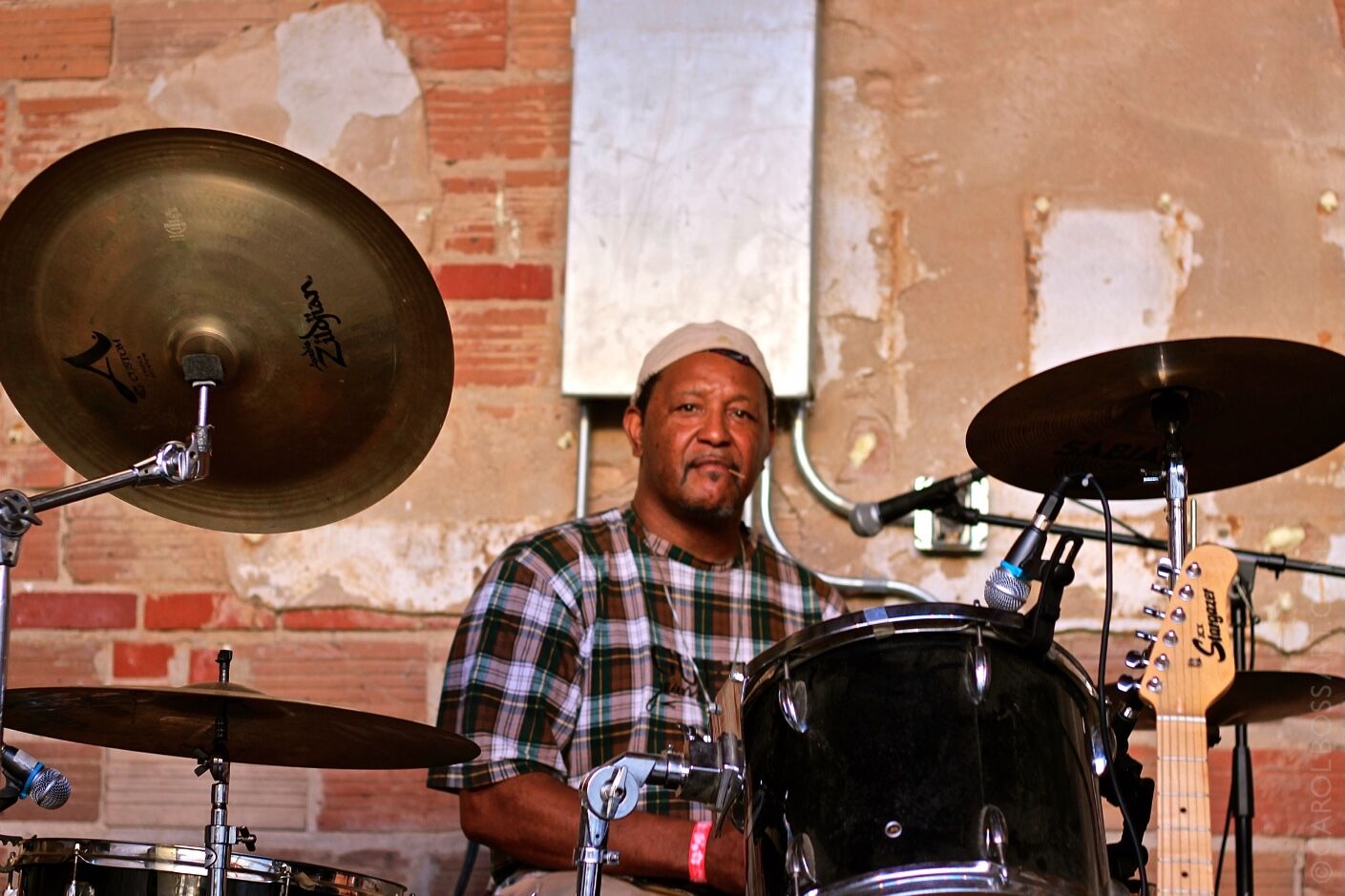
In North Mississippi, blues isn’t just a genre; it’s a groove, a gathering, a way of being. Sit three Hill Country musicians around a table — Kinney Kimbrough, Kody Harrell, and Eric Deaton — and what emerges is less a debate than a shared meditation on rhythm, lineage, and responsibility.
Raised in the juke-joint culture that shaped Hill Country blues, Kinney Kimbrough carries forward his father Junior Kimbrough’s hypnotic, one-chord groove and long collaborated with RL Boyce. Harrell regularly backs Cedric Burnside on the road. Deaton grounds his sound with deep, repetitive bass lines and Indian influences, and released two solo albums, Gonna Be Trouble Here (2006), and Smile at Trouble (2009). All three musicians found Hill Country to be a unique genre.
“I define this as relaxing type music,” Kinney says early on. “We all play the same music, but just a different style. Like we are all eating cake — chocolate cake, strawberry cake — but it’s still cake.” Hill Country blues, he explains, is distinct from Memphis, Chicago, or Delta blues. It’s stripped down, hypnotic, grounded in repetition.
Kody leans into that feeling. “It feels like relaxation, like feel-good music, party music, house party music. Rural back-country — take-a-load-off music. Kick some dust up and groove to it.” He emphasizes that it’s not urban blues. “The biggest city associated with Hill Country blues is Holly Springs (population 7,000).”

That rural identity shaped not just the sound, but the path of the musicians themselves. Unlike Delta players who migrated north during the Great Migration, most Hill Country musicians stayed put.
“Probably because of property,” Kinney reflects. “One wasn’t really about the money down here playing the blues. If you take that music and turn it into a job,” he recalls his father telling him, “you might as well go get you a nine to five. The music you playing is fun music. It’s recess. Treat it like that.”
Eric notes that R.L. Burnside was the rare exception — briefly living in Chicago before returning south after family tragedies. “That definitely is the tendency here,” Eric says. “They stayed.”
The Fat Possum Era
For decades, Hill Country blues thrived locally but remained largely unknown outside the region. That changed in the 1990s with Fat Possum Records.
“It changed a lot,” Eric says. “Until Fat Possum, I don’t think many people knew about Hill Country blues outside the Hill Country.” Suddenly, artists like R.L. Burnside and Junior Kimbrough were getting attention from Rolling Stone and touring internationally.
“Europeans are deep into this stuff,” Eric adds. “You go over there and they know more about the blues from here than we do sometimes.”
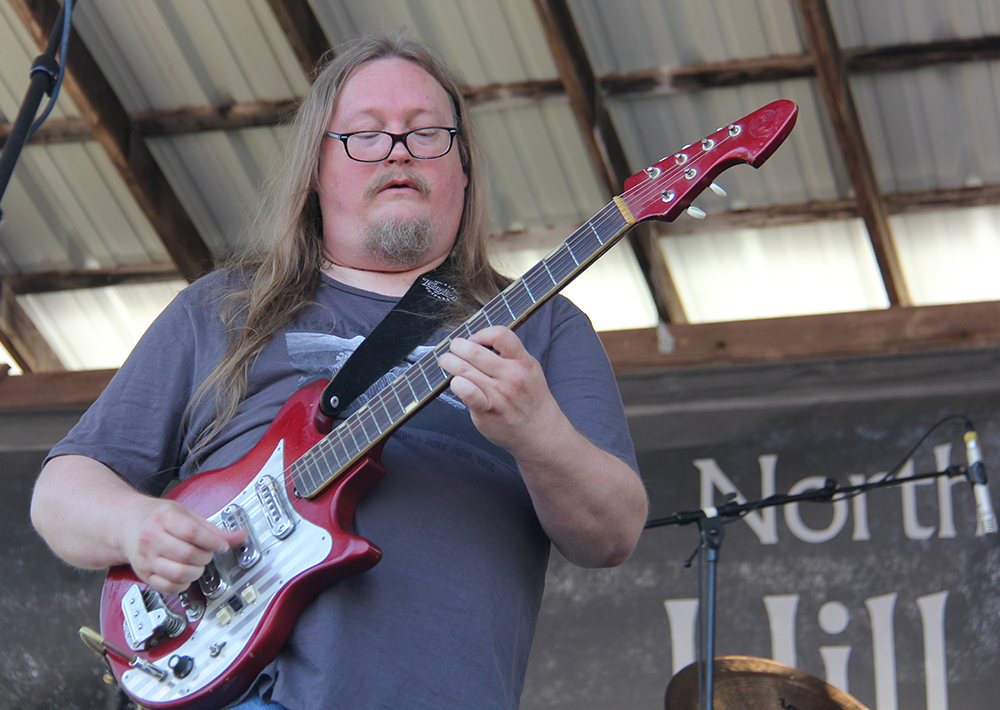
One Chord, Infinite Depth
If there’s one defining trait of Hill Country blues, it’s the groove — often centered around a single chord.
“The biggest qualifying characteristic,” Kody says, “is the one chord or minimal chord groove.” The music’s origins in solo performance shaped that structure. Early players like Mississippi Fred McDowell, R.L., Junior, Jessie Mae Hemphill, and Robert Belfour all began alone — guitar and voice.
“You can’t really change chords too easy when you’re solo,” Kody explains. The result is a droning, trance-like pulse. “It’s almost like meditation.”
Eric adds that the absence of piano in the hills mattered. “The piano is where that whole boogie-woogie stuff came from. That influence didn’t hit this area until way later.” Without piano-driven 12-bar structures, Hill Country blues evolved differently — more circular than linear.
“There are changes,” Kody clarifies. “But they’re implied.” A riff might suggest movement to the four or five chord, but the music often stays rooted in the one.
That can confuse outsiders. “You try to jam with people used to Chicago blues,” Eric says, “they’re liable to get frustrated because it doesn’t do what they think it’s gonna do.”
Kinney laughs. “We can play all the other styles. But you can’t get them to play down Delta. They hate it when we bust out Hill Country blues.”
House Parties and Flickering Lights
Before festivals and international tours, there were house parties — wood porches, mobile homes, fields full of parked cars.
Eric remembers Sunday gatherings after the Hill Country Picnic: “An old mobile home with a wood deck on the front, light beside the door flickering the whole time. Everybody playing on the deck.”
At the legendary juke joints, songs could stretch for half an hour. “Junior might play one song for 30 minutes,” Eric says. Musicians would switch out mid-song without missing a beat.
“It was like a family,” Kinney says. “You need a drummer? Call Cedric. Need a guitar player? Call Dave. All kind of limbs on that tree.”
Onstage they were brothers; offstage, father and son again. Kinney speaks tenderly about his relationship with Junior. “We’d ride and talk. Don’t never talk about no music. Just talk. Maybe about women, drink some cold ones and whiskey.”
Evolution vs. Preservation
Now a younger generation faces a dilemma: how to modernize without diluting.
“I feel the pressure,” Kody admits. “To keep it relevant by modernizing it — adding ensembles, different drum beats.” Today’s rhythms are influenced by hip-hop and electronic music.
Kinney prefers caution. “Keep it like a recipe. Don’t try to add nothing. Keep it raw.”
For Kody, it’s a push and pull. “Sometimes it feels good to go to that other chord. But I don’t want to lose what it truly is.” He thinks of a 1978 video of R.L. sitting by a fence row playing alone. “You don’t want to lose that.”
Eric embraces evolution while honoring roots. He listens to funk, soul, rock, world music. But whatever he writes, he says, “it’s gonna have the spirit and feel of older Hill Country blues. That’s where we’re coming from.”
Pride and Recognition
All three speak with pride — not just in the music, but in Mississippi itself.
“This music being Mississippi music,” Kody says, “iconically North Mississippi Hill Country blues — that’s something I’m proud of.”
Eric calls moving to the hills at 18 the best decision he ever made. “Every show I do, I play at least a little bit of Junior’s and R.L.’s music. Just proud to keep it alive.”
Kinney frames it spiritually: “The music is special. We see it as a spiritual thing happening. Other people see it as a money thing.” His only request? “Recognize where you got it from.”
Because in the hills, the groove isn’t just sound — it’s inheritance. A one-chord meditation passed from porch to porch, father to son, friend to friend. And as long as someone keeps the rhythm steady, it keeps rolling.
