



Growing up, Stud Ford was no stranger to gritty blues clubs with dim lighting, smoke filling the room, and loud music in the air. As a child, Stud would sleep on the floor of blues clubs like Red’s Lounge in Clarksdale, Mississippi, as his grandfather, the Hill Country legend T-Model Ford, played from 6 p.m. to 6 a.m.
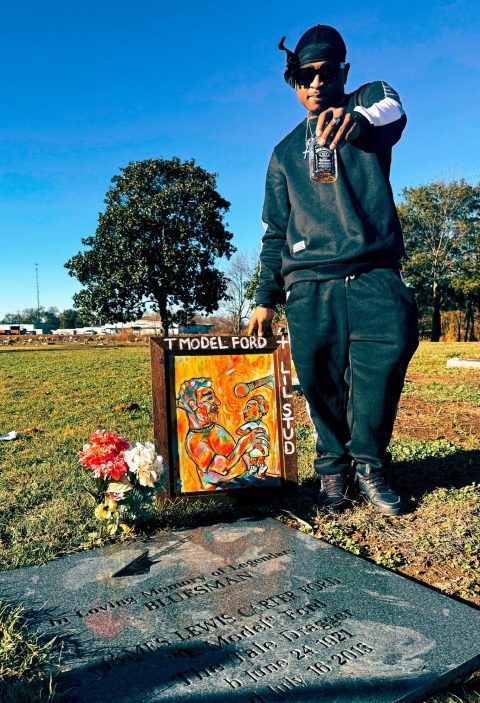
T Model Ford, born James Lewis Carter Ford, was the primary parental influence in Stud’s life and began teaching him music when he was about six years old. Stud said the two were very close, and that his grandfather was the “only person in the world he ever loved” until he had a son of his own. Stud Ford dropped out of school at 14 to pursue music and now carries on his grandfather’s legacy.
“From music, I’ve learned from my granddad that people feel what you feel, and when you are doing your music, if you don’t feel nothing, they ain’t gonna feel nothing,” Stud Ford said. “He was teaching me my culture and how to save it.”
At an early age, Stud gravitated toward the blues all around him. One night, during a drum soundcheck, he saw an opportunity and ran toward the kit. In documentaries from around the time about T Model Ford, Stud can be seen in the background banging on pots and pans and trying to play along with him.
In one instance, guitarist Paul “Wine” Jones told Stud to get off the stage after he started whacking at the cymbals instead of keeping the beat. But T Model Ford saw promise in his grandson, and by around age seven, Stud began getting paid to play music with him.
At age 14, as his grandfather’s health began to decline, Stud started touring with Lightnin’ Malcolm and the North Mississippi Allstars, experiences that broadened his understanding of Hill Country blues and life on the road, especially while working with musicians like Luther Dickinson.
Around the same time, he began picking up his grandfather’s guitar at home, initially just playing along with records for fun rather than with serious ambitions. But after his grandfather died, Ford inherited the instrument and began teaching himself to play in earnest. He has been playing guitar ever since, dedicated to preserving and building on the sound T Model Ford created.
Stud describes his brand of Hill Country–inspired music as “world music” because it is influenced by sounds from across the U.S. and beyond Mississippi. Stud has lived in Colorado, New Mexico, Minnesota and traveled internationally, soaking in the “energies and vibes” of different places. Still, the Southern juke joints he grew up around remain among his most formative influences.
“In my brain, I built this jukebox of music and I put those influences into my own songs. It comes out sounding like a lot of Hill Country,” Stud said. “When you go into Hill Country, because it’s so droning and hypnotic, it’s easy to add influences of hip-hop, rock and roll, singer-songwriter, church, or country music. Put it all together, and you get my sound.”
North Mississippi Hill Country blues is characterized by a hypnotic, trance-like groove, Stud said.
“It’s hypnotic; there’s not a lot of soloing and not a lot going on musically, but it’s made to put you into this trance,” Stud said. “I like to look at it as almost like tribal music — these native sounds and rhythms that pull you into that hypnotized feeling.”
Delta blues, by contrast, Stud said, relies more heavily on chord changes, particularly the classic 1-4-5 progression. T Model Ford often straddled the line between the two traditions, according to his grandson.
“When you go into the depths of Hill Country blues, you’re really just vibing off the rhythm — keeping the bass with your thumb while doing the lead at the same time with your fingers,” Stud said. “Then you get into this hypnotic trance that people can’t get out of. Even if you go somewhere else in the song, the progressions still tie back to that trance. It’s almost like the notes and the rhythm start talking to you.”
Hill Country’s rhythm-first approach appeals to Stud’s roots as a drummer. He said that even when he plays the guitar, he approaches it like percussion.Ford has continued releasing new music while touring. In 2025, Ford put out an EP titled Ain’t No Love, a collaboration with Will Coppage, along with solo singles including “Ain’t No Looking Back” and “Juke Party,” available on major streaming platforms.
He has also collaborated with other musicians, including a project with Lightnin’ Malcolm titled Rough Out There and the 2017 album Kalamath with Colorado musician AJ Fullerton, which reached No. 1 on Colorado blues charts. Ford said he is currently working on additional recordings with guitarist Mark Stone while continuing to develop new solo material.
Moving forward, Stud hopes to incorporate new influences into Hill Country blues while preserving its core sound.
“That’s where I’m trying to take it,” Ford said. “We’ve got to break it out of being put in a box as just one genre. Not enough people know how to play it or rewrite it, and not enough people even know about it.”
Stud added that while Chicago blues and rock and roll are widely recognizable, many styles of modern music draw from the broader blues tradition.
“Because I’m younger, I feel like I have the upper hand,” he added. “I can put all these sounds together. Just like country is mixing with hip-hop right now, and hip-hop is crossing into other styles, the same thing can happen with blues.”
Stud believes he was meant to play the blues. Although at times he questioned the path he took — missing out on school and time with friends — he now accepts the responsibility and privilege of carrying on Hill Country music.
“That was my journey. I was supposed to go through this, and now I’m able to see it that way.”
“This has to be the thing to revive it. That’s what my granddaddy instilled in me,” Stud said. “That’s why he did this stuff, sleeping on floors in these chitlin’ circuit joints at night when I was crying because I wanted to go home… I just want to help do my part for my generation so my son and my nieces and nephews come up in the world and know what real music is.”
Aside from being a good father, Stud said “all he lives for” is preserving the musical legacy of T Model Ford.
“I don’t really care if I win a Grammy. I really care about nothing in life. I just care about making sure my granddad’s name stays alive because he saved my life,” Stud said.
T Model Ford taught life lessons through music. As a grown man, Stud said he now understands many of the things his grandfather tried to show him — lessons that were not always spoken directly, but expressed through music. Above all, T Model taught him to keep his word, to act with integrity, and to stand up for what he believes in.
Touring with Lightnin’ Malcolm and later the North Mississippi Allstars at just 14 and 15 years old was a formative experience for Stud. The veteran musicians taught him the music business — how to present himself professionally, conduct interviews, and perform alongside musicians he had never met before. With both groups, Stud toured across the U.S. and in Canada, expanding his view of the world beyond Mississippi.
“Man, they are good guys. They taught me so much: how to play music, how to make people feel, how to do my thing,” Stud said. “They nurtured me and they loved me and they gave me what they could.”
In his own music, Stud explores heartbreak, young men forced to grow up quickly, the cultural effects of past trauma, generational struggles, politics, race, love and happiness.
“These are my stories that actually happened in my life and other people’s lives that can relate to me in my generation,” Stud said. “That’s the thing about music. When someone is living what people are going through and talking about it through music, people can relate. I try to preach just love yourself and love your neighbor. Be genuine and remember that we are human.”
T Model Ford and Stud Ford shared a deeply close relationship. Stud remembers trying to make his grandfather laugh on the road, tickling him and joking around. On one occasion, Stud was allowed to shave him and accidentally cut up his face, but T Model simply smiled. Stud now has to shave every two days and says he thinks about his grandfather each time.
Stud also said his grandfather was famous for eating honey buns or rice during the day, and would often leave half of the food for Stud to eat when he came home from school.
Stud Ford said his grandfather had a difficult childhood marked by abuse and instability, experiences that stayed with him for the rest of his life. Despite that past, Ford said T-Model Ford placed a strong emphasis on making sure his grandson attended school whenever possible.
Ford’s own upbringing was complicated. His father was largely absent and spent time in prison, while his mother struggled at times, leaving his grandfather to step in and raise him. The household itself could be tense, with frequent arguments and financial strain, but Ford said his grandfather stayed largely to provide stability for him until he was old enough to begin traveling and performing.
By his teenage years, Ford said he was effectively living with his grandfather full time, and the two grew extraordinarily close — a bond he describes as the defining relationship of his childhood.
Stud said he is proud that, like his grandfather, he taught himself to play guitar. He also performs only three covers — “Po Black Mattie,” “All Night Long,” and “Take Around Me.” Most of his music is original, drawing directly from his own life.
“I want to cross over, man, to take it to new levels,” Stud said. “To let people understand the blues as simply music.”
Hill Country blues, for Stud, is above all about authenticity.
“I love how real the music is, because you have to be real. If it’s fake, you’re not going to feel it,” Stud said. “With Hill Country blues I love those trance-like beats — people dancing, jumping, all in unison with the music, the heartbeat, the pulse of the skin.”
From the start to the end of a set, Stud sees blues as a healing force.
“Man, just love, bro — love. The blues is love.”
