


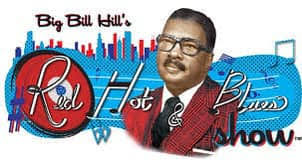
It was a Friday night ritual. As a teenager in the Chicago suburbs, I used to watch blues DJ Big Bill Hill’s Red Hot & Blues, a teenage soul-music dance show that aired in gloriously grainy black-and-white during the late ’60s and early ’70s on Chicago’s low-budget UHF channel WCIU-TV. A few friends and I even had our own little fan club; we’d gather to watch every possible Friday night.
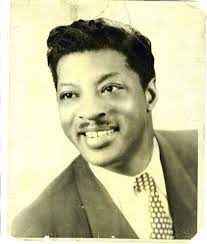
Big Bill Hill was born in 1914 in England, Mississippi, and arrived in Chicago around 1962. And Big Bill was indeed big—reportedly six feet tall and 250 pounds. He first found work in a steel mill, but his real ambition was to host a radio program.
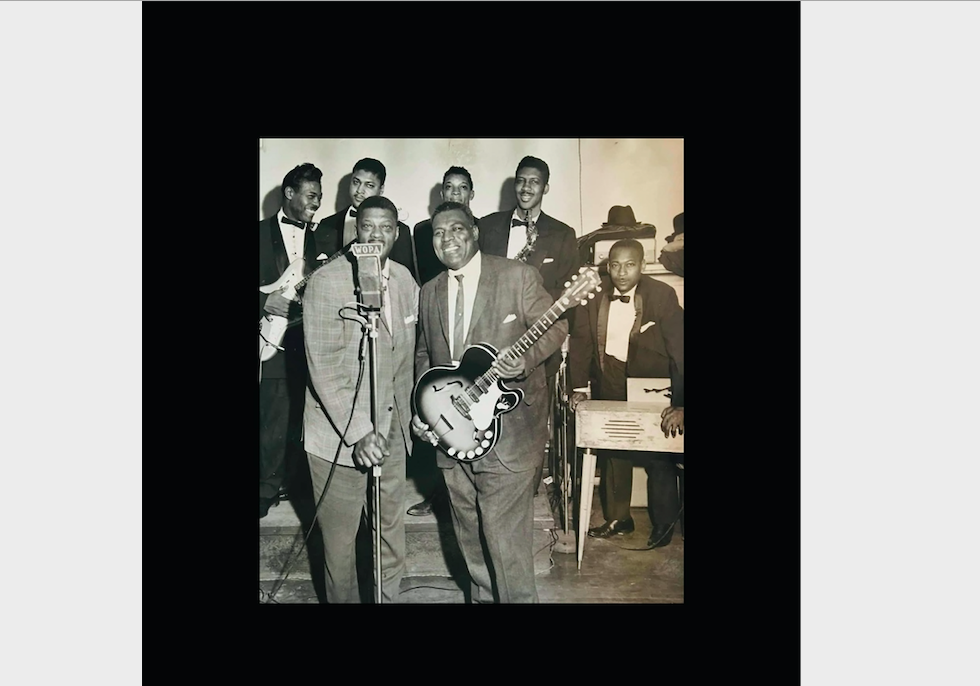
Hill found work as a DJ on WLDY-AM in Elmwood Park, and later on WCRW-AM, WGES-AM (programmed by blues impresario Al Benson, known as the “Old Swingmaster”), and eventually, around 1953, at WOPA-AM—his longest-running and best-known outlet—where he championed local blues and R&B records, helping break artists at a grassroots level. His shows were generally brokered, meaning he purchased the airtime and then sold his own advertising.
WOPA-AM was owned by Chicago broadcaster Emil Denemark and operated out of the Oak Park Arms Hotel in suburban Oak Park, Illinois—a quiet residential hotel that improbably housed one of the region’s key outlets for grassroots blues and R&B radio on its top floor. Its FM counterpart, WOPA-FM (later WGLD-FM), became the city’s first underground free-form FM rock station in the late 1960s before flipping to automated R&B/dance as WBMX-FM.
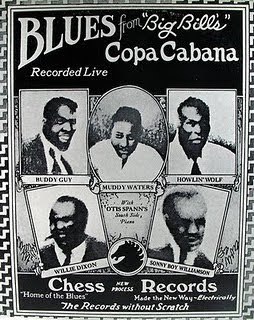
In the 1960s, Hill also ran the Copa Cabana nightclub, a regular stop for working blues musicians and touring acts. Located on the city’s West Side—Lawndale/Garfield Park, along the Roosevelt Road entertainment corridor—the small space functioned as a working blues bar promoted by his radio presence. Among the artists who played there were Eddie Shaw, Little Mack Simmons, Mighty Joe Young, Lefty Dizz, and Hound Dog Taylor.
Hill also had a record label—or at least an imprint. Colt Records was an outgrowth of his Colt Booking Agency and part of Carl Jones’ C.J., Colt, and Firma Records, which released many of the artists Hill booked at his club and played on the radio. It’s a bit of a gray area, however, as Jones appears to have issued his own productions interchangeably across C.J., Colt, and Firma—early home to artists like Lee Jackson, Hound Dog Taylor, Little Mack Simmons, Homesick James, Eddie Shaw, and Betty Everett.
Eventually, Hill added television to his butterfly net of ventures, landing a brokered R&B dance show on early UHF channel WCIU-TV (Channel 26), arguably Chicago’s lowest-budget, lowest-fidelity TV station at the time. This was long before cable; UHF might as well have been broadcasting from Mars, requiring a ring-shaped antenna alongside the standard VHF rod just to tune in.
WCIU-TV, founded by John J. Weigel (its call letters standing for “Chicago Independent UHF”) and taken over by businessman Howard Shapiro in 1966, was known for its eclectic, often multi-ethnic programming. Other WCIU productions included Kiddie-A-Go-Go (a kids’ rock ’n’ roll dance program) and the children’s horror-comedy show Svengoolie, as well as an early foray into probing Black journalism titled Blacks’ View of the News. One of its reporters was a noted Chicago broadcaster and soul “record hop” host named Don Cornelius.
Red Hot & Blues itself was as raw as television got in the 1960s: R&B and funk records playing (occasionally skipping), teenagers dancing, and live, straight-to-camera advertising between records. Local businesses pitched everything from nightclubs to upholstery shops without polish or pretense.
The standout advertiser was Don Walker of Don’s Cedar Club, located in the Wicker Park area prior to that neighborhood’s gentrification. Hill would introduce Walker as “the mate that pays the freight…here’s Don!”
Each week, Walker brought in the club’s blues acts—notably Eddie Shaw, Little Mack Simmons, and Mighty Joe Young—who would lip-sync to their respective 45s (which were occasionally prone to skip mid-performance—such were the perils of lip-syncing on live TV). Occasionally, Shaw would play his achingly soulful tenor sax instrumental, “Blues from the West Side.”
Walker, a middle-aged white bar owner, reiterated his credo each week: “I don’t care if you’re Black, white, green, yellow, or purple. I require that you be a lady, a gentleman, 21 years of age, and able to prove it.”
There were non-musical advertisers, too—like Dell’s, a reupholstery shop on West Madison Street. Its spokesman, Bobby Hicks, repeatedly pronounced it “Dale’s” and made his appeal to those who didn’t necessarily believe they could afford reupholstery: “I don’t care if you have good credick, bad credick, or no credick at all.”
Hill himself had a distinctively subdued delivery—bluntly described by one blogger as “wooden.” “Nine” became “ny-un.” So a phone number might come out as: “That’s ny-un, ny-un, five…”
You’d hear a lot of James Brown, the Watts 103rd Street Band’s primal “Do Your Thing,” Edwin Starr, King Floyd, Jean Knight, and Chicago artists like Tyrone Davis, Syl Johnson, Little Milton and Curtis Mayfield.
Reportedly, Red Hot & Blues ran until 1971. There were no newspaper reports of its demise, and no known videotapes—nor even still photos (I’ve searched…for years). It existed only in the moment. I consider myself fortunate to have been there. It was truly the end of an era.
Amid changing times, a far more sophisticated and viable soul dance show would soon make its debut on WCIU in 1970.
Hill’s WCIU program—with its dancers and lip-synced performances—closely anticipated what Don Cornelius later refined and brought to national prominence with Soul Train, which debuted on WCIU on August 17, 1970. Its first episode featured Jerry Butler, the Chi-Lites, and the Emotions. Soul Train moved into syndication on October 2, 1971, airing weekly thereafter, with its home base eventually shifting to Los Angeles where it remained for the duration of its run. Its final season was 2005–2006.
In interviews, Cornelius consistently presented the show as his own creation, and any direct acknowledgment of Hill as a specific precursor appears to be absent. But those of us who were watching Red Hot & Blues didn’t need to be told—we’d witnessed the archetype in real time.
