


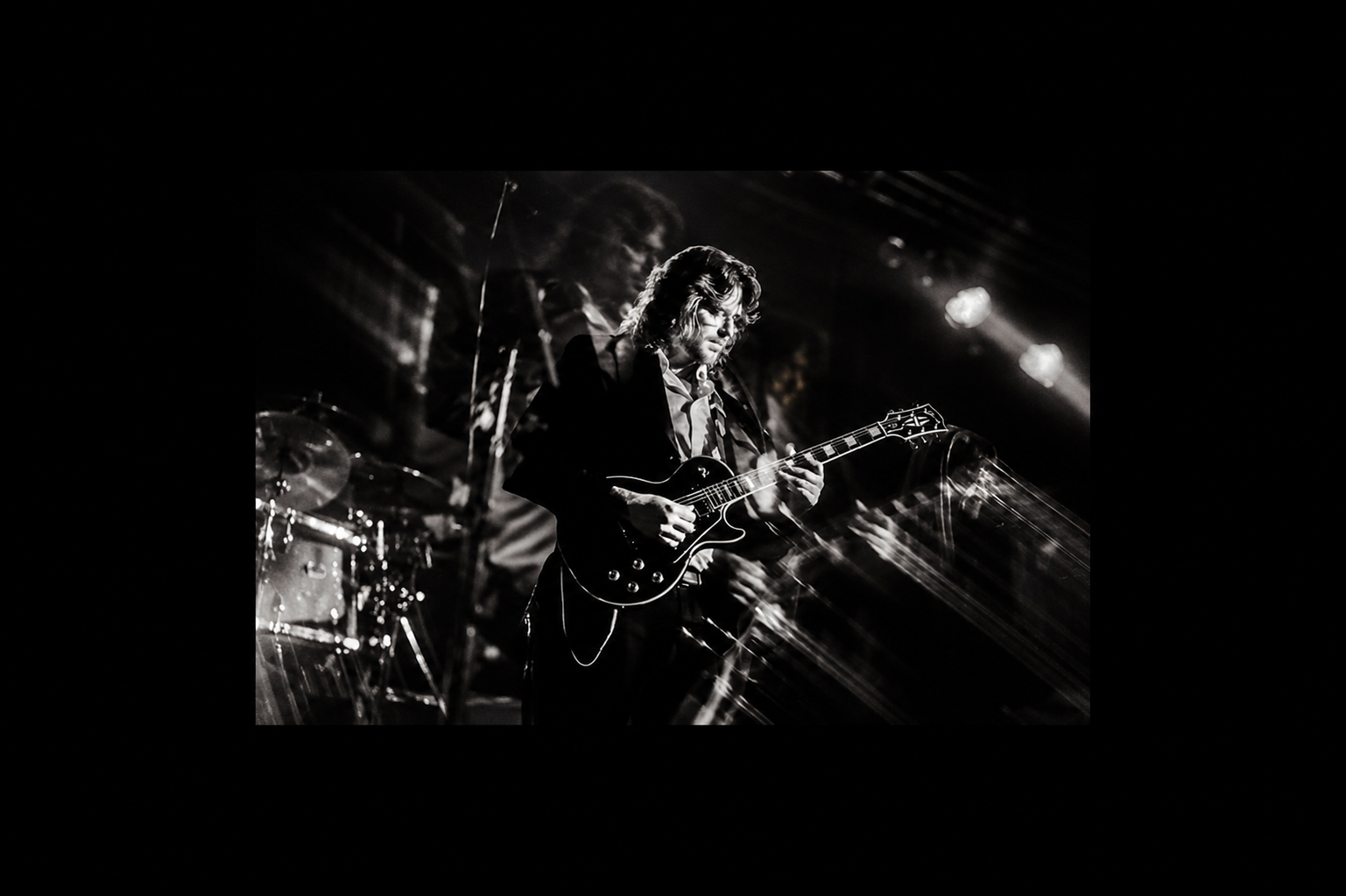
The Kid Who Thought Elvis Was Family
Matthias Lamparter grew up believing Elvis Presley was part of the family.
In Tennessee, relatives casually referred to the rock-and-roll icon as “Uncle Elvis,” a nickname rooted in family ties near Memphis. Lamparter took it literally. It was not until grade school — after proudly telling classmates that Elvis was his uncle — that he realized the King belonged to everyone else, too. By then, music had already taken hold of him. At eight years old, Lamparter used a $50 check from his grandfather to pay for his first guitar lessons. Soon, he was sitting in his room obsessively switching between chords until his fingers bled.
“I just did it for a week,” Lamparter said. “I was obsessed with it.” Music entered Lamparter’s life through a household steeped more in rock and roll than country music. His parents were devoted Aerosmith fans, and one of his earliest concerts was seeing Meat Loaf at just four years old. Long before he understood the mechanics of guitar playing, Lamparter was already drawn to performance itself. “I was more of an entertainer than anything,” he said. “I was always that kid that had some little song-and-dance routine.”

His father encouraged him to stick with guitar fundamentals, telling him that if he learned chords and structure, he would eventually be able to play anything he wanted. Lamparter quickly became consumed by repetition and muscle memory, learning AC/DC riffs while building the calluses necessary to keep going.
Then, suddenly, music stopped. After his grandfather died, Lamparter broke a guitar string. In the chaos surrounding the loss, nobody replaced it. The guitar sat untouched for nearly two years. For a while, Lamparter drifted elsewhere, including a brief childhood obsession with The Matrix that led to an unexpected fascination with suits and ties. Eventually, his father nudged him back toward creativity. “He was like, ‘You need a creative outlet,’” Lamparter recalled.
Long before probation violations, late-night bar gigs or his debut album 15 Seconds of Fame, Lamparter’s life was already becoming a story about repetition, failure and trying again. “You very rarely get things right on the first time,” he said. Now, after years spent bouncing between street performances, county jails, college-party stages, DJ livestreams and Nashville clubs, Lamparter is stepping fully into the spotlight with 15 Seconds of Fame, his first major solo LP.
The nine-track record — produced over two years alongside producer Chris Silverio and shaped by multiple engineers across Nashville and beyond — blends Southern rock, blues, country, soul and electronic influences gathered across Lamparter’s winding musical life. More than a debut album, the project represents a hard-earned reinvention: a record about movement, survival, authenticity and redemption from a musician who spent years learning how not to compromise himself.
Knocking on Garage Doors
Once Lamparter returned to guitar, he pursued music with gumption and moxy. Growing up in Tennessee suburbs, he wandered neighborhoods listening for live music. Whenever he heard drums coming from a garage, he knocked on the door, guitar in hand.
Then came the knock that changed his trajectory. Lamparter stumbled into a family deeply tied to the local rock scene — complete with Marshall stacks, rehearsal rooms and musicians who took the towering teenager seriously. One younger drummer immediately stunned him. “This kid was just ripping at drums,” Lamparter said. “Child prodigy status.”
Soon, Lamparter was playing birthday parties, church gigs and local shows. By middle school, he was already functioning as a lead guitarist in church bands. By high school, he had become immersed in Tennessee’s broader music culture. At 6-foot-7, Lamparter gravitated toward older crowds, eventually sneaking into Nashville bars with fake IDs and playing anywhere that would let him plug in.
“You can’t escape what’s going on here,” Lamparter said of Tennessee music culture. “Country music is so big.” Even though his formative influences included Green Day, Jimi Hendrix and My Chemical Romance, Nashville slowly seeped into his instincts through sheer exposure. He began noticing how blues, country and Southern rock all connected beneath the surface.
“You start seeing how country music kind of shaped everything around it,” he said.
Playing for Tips and Learning Crowds
As a teenager and young adult, Lamparter learned how to survive through music. He played downtown Nashville streets for tips. He performed on bridges in Chattanooga. Sometimes the money covered little more than gas and a sandwich before driving back home to construction jobs the next morning.
“Music was a way to fund itself,” he said. Street performance taught him how quickly audiences make decisions. He honed looping guitar techniques and learned how to jump into choruses at the perfect moment to pull passing crowds closer.
“I’d just sit and wait,” he said. “Then they’d come around the corner and I’d hit the chorus.” Even then, Lamparter was forming a broader philosophy on performance that extended beyond the music itself. Lamparter became obsessed with the invisible chemistry between artist and audience. “My genre is head nod,” he said. “If you can nod your head, that’s it, dude.” Rather than chasing strict genre boundaries, Lamparter focused on emotional rhythm and crowd connection. “I think my sound is defined by the song, not the guy who’s singing it,” he said.
Jail Time, Probation, and Stalled Momentum
At 18, Lamparter’s momentum collapsed. Legal troubles and probation violations consumed much of the next seven years of his life, repeatedly interrupting opportunities and derailing musical progress. “I had all this shit going and everything was rolling,” he recalled. “And then it’s like, ‘Oh shit. You just got a couple felonies. You need to chill.’” Lamparter spent time in county jail while navigating years of probation restrictions. Music became difficult to sustain while constantly worrying about violating parole conditions or getting pulled back into the legal system. “When you’re always not supposed to be there,” he said, “you always wanted to pop in, but you didn’t want to stay too long.”
Slipping in and out of bars, clubs and scenes before trouble could catch up became a defining pattern during those years. It also slowed his ability to maintain lasting industry relationships. “It takes a long time to make connections when you’re popping in and out so much,” he said. Still, music never fully disappeared. Lamparter worked at pawn shops repairing guitars and teaching lessons while flipping gear to stay afloat. He immersed himself in instruments, amplifiers and electronics, unknowingly laying the groundwork for future guitar-building projects.
The period also forced him to rethink himself more broadly. “This is the penance,” he remembered thinking. “Like, I’ve got to really be on my shit.” Over time, Lamparter began viewing those years less as pure failure and more as an education in accountability, patience and second chances.
Reinvention Through Simply Majestic
By 2019, Lamparter had finally emerged from years of legal entanglements and committed fully to music again. Almost immediately, new doors opened. One of the most important came through Simply Majestic, a live guitar-and-DJ collaboration that paired Lamparter’s improvisational instincts with electronic dance music and livestream performance culture.
The project began after a DJ invited Lamparter to join a rooftop cocktail-hour set at Nashville’s L27 rooftop lounge. Lamparter built a custom monitoring and effects setup so he could improvise freely alongside DJ mixes in real time. “We had a packed dance floor and we were vibing,” he said. Then COVID arrived.
Rather than shutting down, Simply Majestic adapted into livestream performance. Lamparter and collaborators built multi-camera streaming setups and performed online DJ sets for virtual audiences, corporate events and Twitch livestreams through Music City Radio – a format pushing Lamparter musically in entirely new ways.
“To force your brain to improv for three hours and be interesting as a guitar player on top of a DJ setup,” he said, “nothing really makes me feel as alive as that.” The experience sharpened his instincts for arrangement, pacing, and crowd psychology. It also reinforced his belief that authenticity matters more than technical perfection. “The moment that you’re not being genuine,” he said, “they can tell.”
15 Seconds of Fame
Lamparter had released 9 singles before under “The Matthias Project”, but 15 Seconds of Fame feels different to him. “This is my first putting it all in,” he said. For the first time, Lamparter is not a supporting player, collaborator, or side-project guitarist—but the central voice tying it all together. The album began taking shape after Lamparter met producer Chris Silverio at a Christmas party. Lamparter had spent years sitting on unfinished material, unsure how to fully realize the songs in his head.
Silverio helped change that. “Without his direction,” Lamparter said, “I would have kind of always stayed more in the home-studio electronic drums world.” Together, they built a record that combines live-band performances, horns, pedal steel, Southern rock textures and electronic production influences gathered from Lamparter’s years in both band and DJ worlds.
Many vocals were recorded live in the room with the band. “It was like, okay,” Lamparter said. “‘Here’s my 15 seconds of fame.’” One song in particular — “Concrete Cowboy” — became the album’s creative turning point. The addition of horns unlocked a broader sonic direction for the record.
“There’s such a magical sound to that,” he said. “Everything can live within that.” The album also draws heavily from Lamparter’s Southern influences, particularly the improvisational looseness and emotional directness of blues, rock and country storytelling. “I think there’s something about saying more with less that blues and rock and country and Americana have all mastered,” he said.
Every song, he explained, represents a different chapter of his life. “I wanted to tell this story of where I am and how I feel about these subjects and these things,” he said, “and make room for other people to hear their story in it as well.”
Learning Not to Compromise
Years spent touring college circuits across the South further sharpened Lamparter’s understanding of performance. He played fraternity parties, packed backyard shows and university events where crowds could shift from euphoric to indifferent almost instantly.
“They can tell when you’re being genuine,” he said. “The moment that you’re not being genuine and you’re just going through the motions, they can tell.” Lamparter remembers one post-lockdown college performance at Sewanee University where roughly 1,400 students packed into a backyard party so chaotic that security rails bent into the stage while students climbed over one another in the crowd. “We could have been the biggest band in the world that night and it wouldn’t have mattered,” he said. “They were so hyped.”
Experiences like those reinforced his belief that artists lose themselves when they begin compromising purely for convenience or approval. Lamparter’s college circuit years pushed performance into extremes—packed house parties, unpredictable crowds, and shows where attention had to be earned in real time. At one event in Nashville, part of the broader DJ-guitar hybrid era he built with Simply Majestic, the line between performance and spectacle blurred entirely. The event was called the Nashville Undie run.
“It was freezing cold in February, inside a tin roof venue,” he said. “And everyone just took everything off.” Lamparter ended up on stage in his underwear and cowboy boots, improvising alongside a DJ as a packed, chaotic crowd moved with the music. “I just showed up,” he said. “I didn’t even realize that’s what it was going to be.” Those nights, he says, taught him something fundamental about performance: attention is never guaranteed—and never passive. He also learned to value his time. “I’m proud of not taking some opportunities,” Lamparter said. “I’m proud of not being such a yes man all the time.”
He says he intentionally turned down deals and shortcuts that would have required sacrificing creative control. “It took longer because of that,” he said. “But I didn’t have to compromise on anything.”
Building Guitars by Hand
Outside of music performance, Lamparter has developed another artistic outlet: building custom guitars. Through his Dead Pedal Guitars project, Lamparter creates hand-built instruments featuring preserved flowers embedded inside epoxy resin bodies. Each guitar involves weeks of drying flowers, hand-routing wood, layering resin and refining finishes. Two guitars are for sale through Lake Dessie Studio and five custom guitars are in the works.
“There was a lot of trial and error,” he said. Lamparter approaches the instruments with the same philosophy he applies to music — authenticity first. “If I was going to do it,” he said, “I wanted it to be something that I would get up on stage and play.”
The process grew naturally out of years spent repairing instruments and learning technical skills while working construction and electrical jobs. Today, he builds the guitars largely by hand, without CNC automation, emphasizing craftsmanship over speed. “We route everything by hand,” he said. The guitars, much like Lamparter’s music career itself, emerged through patience, experimentation and persistence.
“I Hope They Feel Like They Know Me”
Today, Lamparter says success matters less to him than readiness. “What keeps me hungry is like, I just want to be ready all the time,” he said. He already has another batch of songs waiting to be recorded, along with plans to experiment with tape machines and older analog recording equipment. But for now, 15 Seconds of Fame represents the clearest statement of who he is as an artist after years spent circling the spotlight.
“I hope they feel like they know me a little bit,” he said of listeners hearing the album. After years spent slipping out back doors, Matthias Lamparter is walking through the front door, playing eclectic music loud, ready for 15 seconds of fame.
