


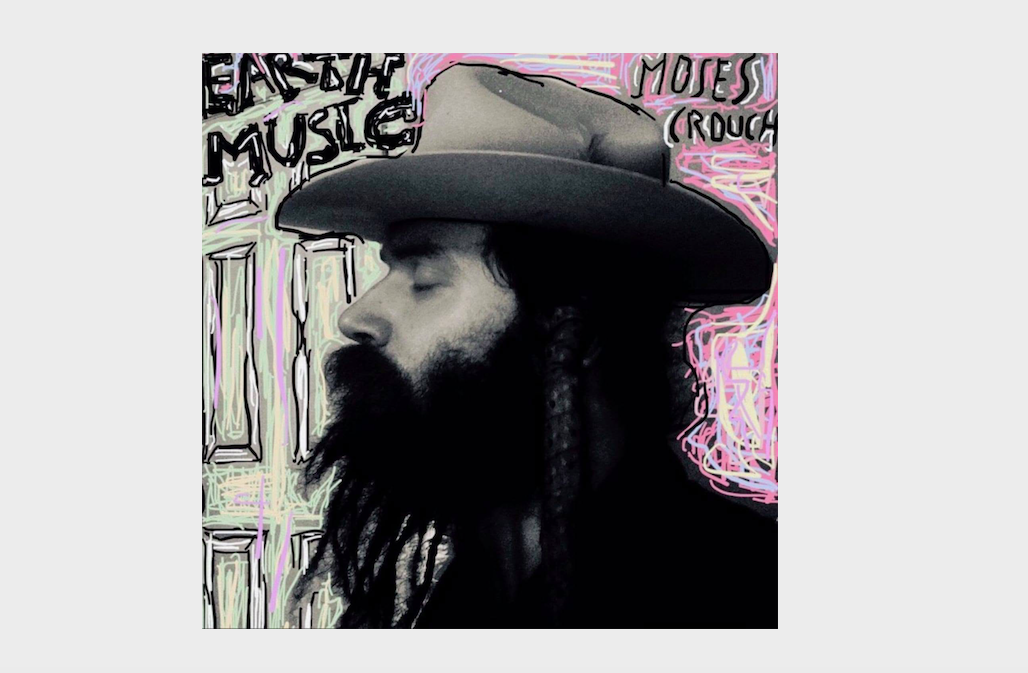
When Moses Crouch plays Hill Country blues, he lets go of the fear of death, ignorance, and darkness, becoming completely transported into a trance state, “a place of existence, consciousness, and bliss.” Crouch, the Memphis native who explores Black folk traditions, Georgia Blues, and Memphis jug music in addition to his Hill Country roots, said the trance state is similar to the feeling he gets when he meditates, “only better.”
For Crouch, North Mississippi Hill Country Blues has one of the most influential yet unmentioned forms of music of the past 70 years. Crouch argued that Hill Country Blues has quietly influenced much of popular music today. While The Rolling Stones have acknowledged the influence of Fred McDowell, and The Black Keys have acknowledged the influence of countless Hill Country musicians, and especially RL Burnside, Crouch said the genre has not gotten the attention and recognition it deserves.
“After I heard it from Fred McDowell, after I heard it from RL Burnside, the groove came natural to me,” Crouch said. “I’m not a fantastic melodic player. I do rhythms and drones.” Crouch grew up in Memphis and at a young age met Chris Chew from the North Mississippi All Stars, who introduced him to Duwayne Burnside and Luther and Cody Dickinson, immersing himself in the HIll Country scene. At 12 years old Crouch started listening to Robert Johnson before “moving up” to Fred McDowell, whom he calls “the patriarch of Hill Country”.
According to Crouch, Hill Country blues is trance-inducing, one or two chord blues, “a holdover from the West African days.” Crouch released his first solo album in 2024, Earth Music, an LP with “howling falsettos, droning grooves, and crooked song structures that resist commercial polish, drawing inspiration from Memphis, North Mississippi, and Georgia’s Piedmont.” The album won best self-produced album from the Memphis Blues Society.
On the LP, Crouch plays some of the older, formative music that would become Hill Country blues. “Old Devil” is a song first written and recorded by Bo Carter of the Mississippi Sheiks, in 1938. Crouch said, of the song, “it has a rhythmic first [approach], focusing on a droning one-chord verse structure culminating in a crooked and unrestrained resolution. This is not 12-bar blues.”
Crouch plays upbeat acoustic guitar, singing “I need my baby before I lose my natural mind and I go stone blind.” The song is simple, soulful, and powerful, reflecting the Hill Country tradition. Bo Carter, a member of the Chatmon family, was a “genius” and a founder of Hill Country blues, Crouch said. He mostly plays in Memphis and throughout Mississippi. Of his entire musical career, he said he is most proud of simply being a part of the Hill Country tradition.
For him the quintessential Hill Country song is “See My Jumper Hanging Out on the Line” by RL Burnside. Other contenders are “”Devil’s Dream” and “The 8th of January”by Sid Hemphill, “Meet Me in the City” by Junior Kimbrough, and “Skinny Woman”, another RL Burnside track. Among his greatest Hill Country influences, Crouch listed RL Burnside, Junior Kimbrough, and especially Sid Hemphill. “Sid predated Hill Country Blues, really. But he was in the hill country,” Crouch said. “And to me, Sid Hemphill is one of the greatest musicians to ever live.”
Flowing freely between the Memphis and Hill Country music scenes, Crouch said that he styles and communities overlap more than they differ. Memphis, however, has “a sheen”, a bit more “city-fied” or urban.
“The progressions come from a kind of a weird unthought-of place. That one or two-chord thing. That’s in the Memphis and Northern Mississippi tradition,” Crouch said. “In Memphis, you kind of put on a sparkling jack and when you’re in Mississippi, you take it off.”
Rhythm is essential in both traditions, Crouch said. “Rhythm and groove are the number one thing. That’s what I was talking about with the trance-inducing music,” Crouch said. “You need rhythm, and you need groove. It’s very difficult to reproduce authentically. A lot of people think that they understand things, and they don’t have any rhythm. They don’t have any groove. You can get the chords right, you can get the melodies right, but if you don’t have that, like, that quintessential groove, then you got nothing.”
Though it employs fewer chords, Crouch said there is nothing simple about HIll Country Blues. Musicians play multiple rhythms at the same time, creating what he described as “multiplative” and deeply layered music.
Crouch said he learned about attitude and mojo from Hill Country musicians, particularly Duwayne Burnside. Players detect moods and vibes before a note is even played. Because of something that shone through in Crouch’s character, Crouch said that he felt he was accepted into the Hill Country community almost immediately. “It’s a feel, man.”
While Crouch’s own family doesn’t play music, he feels like he has become a part of the Hill Country musical families. Crouch noted that the tradition is passed down generationally — from Sid Hemphill to Jesse Hemphill and from RL Burnside to Duwayne Burnside, to both children and grandchildren.
Crouch spent time deciphering Belton Sutherland lyrics, one of the oldest Mississippi bluesmen. Crouch worked with the Mount Zion Fund, who places headstones on graves of musicians, including Sutherland. Crouch called Sutherland an excellent player, and recalled his infamous line; “Kill that old grey mule; burn down the white man’s barn.”
Even if the music drifts from its origins in juke joints and backyard parties, Crouch is confident it will retain its authenticity. “They are who they are, and they do what they do, no matter where they go,” Crouch said.
Ryan Coogler’s 2025 blockbuster vampire blues film Sinners has been a boon for the genre, Crouch said, exposing a wide audience to the blues: “It got through to them. I don’t think much of the music gets lost.”
Crouch added that the music has remained intimately and essentially tied to its Mississippi roots. While younger musicians are pushing the genre in new directions, incorporating hip-hop and R&B, the music retains its core and is fundamentally a product of North Mississippi, Crouch said.
Rather than sitting down and forcing himself to write songs, Crouch said he has a spiritual songwriting process that evolves naturally. He promised that more Moses Crouch albums will follow.
