


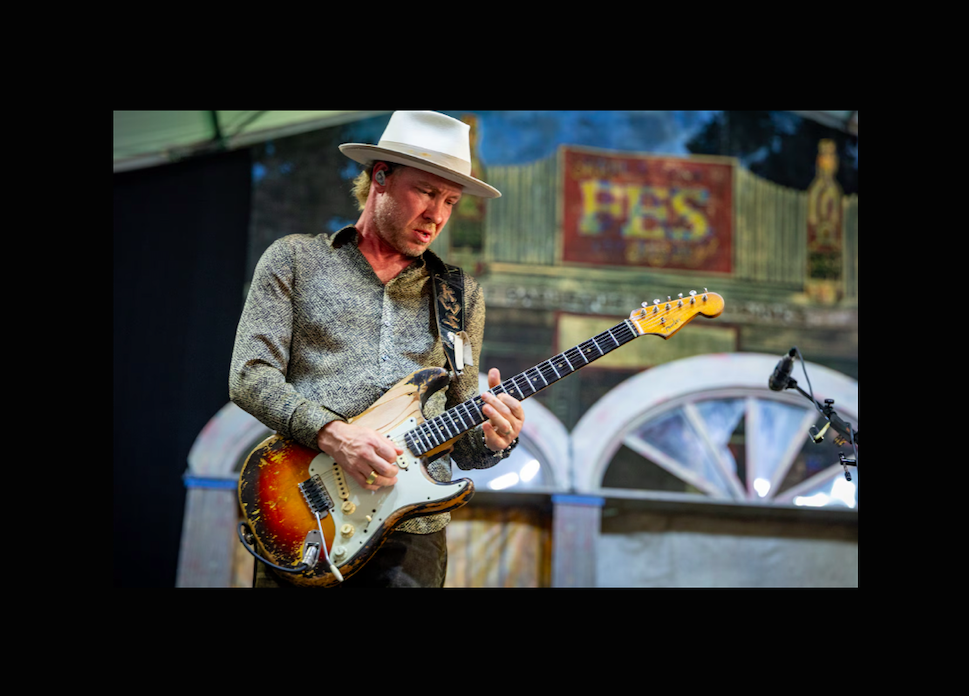
Kenny Wayne Shepherd saw Muddy Waters and John Lee Hooker play at just 3 years old. As he tells it, it was a formative experience. He was meant to play the blues. Shepherd, the decorated blues-rock artist emerged as a strong force as a part of a blues revival in the 1990s with his albums Ledbetter Heights (1995) and Trouble Is (1997), released while he was still a teenager.
In Shreveport, Louisiana, Shepherd grew up around music. His father was a disc jockey and a program director at multiple local radio stations, and was constantly listening to the radio when he wasn’t on air. With Shepherd’s father receiving tickets and backstage passes through the radio station, Shepherd received an intimate, expansive look at blues and rock at a young age.
At just 4 years old, Shepherd began playing with plastic acoustic guitars with nylon strings, gifts from his grandmother from the Green Stamp store. After seeing Stevie Ray Vaughan play, at 7, Shepherd felt that he needed a real electric guitar. By 13, Shepherd was on the stage. By 14 he cut his first demos in the studio. By 15 he formed his own band. At 17, he recorded his first album.
Shepherd wrote Ledbetter Heights at 16 and recorded it at 17. He is still proud of the record.
30 years later, Ledbetter Heights remains a critical and commercial success, and Shepherd is extending his 30th anniversary tour of the album that put him on the blues-rock map. From the outset, Shepherd has straddled the line between blues and rock. Where Shepherd grew up, in Louisiana, was a melting pot of country, jazz, blues, rock, Cajun, and zydeco music, he said.
From Ledbetter Heights to “Blue on Black”
“I think you hear all of that, you know, especially over the course of my entire recording career,” Shepherd said. “There’s just good music and bad music, There’s no genres and labels. To be a true artist you shouldn’t be walled into a box. You should be able to explore wherever your inspiration leads you. But blues is always the foundation for me. Everything kind of starts with the blues.”
In trying to record Ledbetter Heights, Shepherd wanted to hopefully create an album with songs that would be timeless, and not trapped in a specific era or genre. He said that even though people have less disposable income, people are spending hard-earned money to hear him play the tracks he recorded over 30 years ago. To him, that means he succeeded in making timeless music, and that the music still stands up today.
“I think part of it is because I never was trying to be a pop star. I wasn’t trying to chase whatever the cool sound was at the time,” Shepherd said. “Because inevitably, whatever the pop thing is, it’s going to trend its way out. So I was just trying to write music that would stand the test of time.”
Shepherd added that he wanted to write songs that would end up getting played on classic rock radio – songs that people will listen to forever. With, “Blue on Black”, from his second record, Trouble Is… Shepherd succeeded in that goal, with his most popular song.
According to Shepherd, people have interpreted the lyrics in many ways over the years – as an allegory for domestic abuse, about the death of a loved one, or about a broken relationship. Shepherd said the beauty of music is people can apply lyrics to their own experience, and ultimately listeners can interpret the music as they wish.
In terms of the real inspiration for the song, it’s much more mundane. While jamming out with Tia Sillers, Shepherd happened to be wearing a shirt that was blue and black. The pair thought of the concept of how when blue and black mix, the black consumes the blue. What followed was creative, iconic lyrics; “Blue on black/ Tears on a river / Push on a shove /It don’t mean much / Joker on jack / Match on a fire / Cold on ice / A dead man’s touch.”
Shepherd said he has never tired of performing “Blue on Black,” despite playing it nearly every night for 29 years. He recalled hearing as a young musician about a country artist who reluctantly recorded a song that became the biggest hit of his career, leaving him stuck playing a song he hated for the rest of his life. The story stuck with Shepherd, who resolved never to record a song he didn’t genuinely enjoy. Fortunately, “Blue on Black” still “hits every night”.
Reflecting on Ledbetter Heights and Trouble Is… Shepherd acknowledged the greater impact the albums had on reviving blues in the 90s. With some nostalgia, Shepherd said that the era still relied on radio play and selling records, rather than the streaming model that dominates today. Today, he said, it would be nearly impossible for a blues-based artist to hang a platinum album on their wall.
“My record… reignited the new era of the younger generation of blues artists. There’s a lot of those people from my generation that are still doing it today and very successful. We’ve all stood the test of time,” Shepherd said. “It was just an awesome time to be making music because there were still so many elements of the music industry that were the old-school way of doing things.”
With 6 grammy nominations, for both blues and rock, Shepherd has come close to one of the highest honors in music time and time again. Yet, that’s not why he plays the music, he said.
“Anytime you’re nominated for an award like that, you hope to win, and it’s disappointing when you don’t. But at the end of the day, when I first started playing guitar, I was just playing for myself in my bedroom, man,” Shepherd said. “I dreamed about what it might be like to do this for a living, but I wasn’t, like, writing a song hoping that I would win a Grammy for it. You have to stay in touch with the reason why you make music in the first place, and that’s for the love and appreciation of the music. Otherwise, the joy starts to get sucked out of it.”
“I’ve created something that people still want to listen to, like, decades after it’s recorded. These people are singing along to these songs that are 30 years old,” Shepherd said. “They’re buying tickets to this concert to see us play this music. I still have a career that’s thriving 30 years later. So, to me, that’s mission accomplished.”
Keeping the Blues Alive by Letting It Evolve
In Shepherd’s view, contemporary blues is moving more and more towards rock. At the same time, he said there will always be people preserving traditional blues. Recordings will last forever. Shepherd said he finds freedom by drifting between rock, traditional, and contemporary blues. He noted that rock and roll in the 60’s was closer to the original blues sound than rock today.
“Anytime that you’re walking the line between two genres, it just opens up more possibilities. You can absolutely do more if you bring the rock side into the blues,” Shepherd said.
Traditional blues music, he said, relies on a 12-bar structure and three chords. Blending it with other genres allows musicians to experiment with different chord changes and vocal melodies, keeping the music interesting and helping it evolve. “It’s a necessary way to make it continue to be relevant in modern times,” he said, while acknowledging the importance of musicians who preserve the traditional sound.
Shepherd’s influences extend beyond blues and rock. Growing up in Shreveport, Louisiana, which he described as a “melting pot of music”, Shepherd absorbed jazz, Cajun, Zydeco, Hank Williams, Elvis Presley, and Leadbelly. Over a 30 year career, and in his recorded output, Shepherd said, all of those influences can be heard.
Looking at the future of blues, Shepherd said he is particularly impressed with Marcus King, Christone “Kingfish” Ingram, Samantha Fish, and Ally Venable, who are taking the music in new directions, evolving blues and blues rock.
Over the years, Shepherd’s songwriting process hasn’t changed much, but he reaches greater depths while crafting a song. Like anything, he said, improvement comes with time. 90% of the time songs start with an idea – a groove or a riff – on the guitar, and then he builds lyrics and vocal melodies on top of that.
Beyond the Blues-Rock Label
Over his career, and even after 13 solo albums, Shepherd has received criticism that he isn’t a “legitimate blues artist”. Yet, he said, from the onset, he was never trying to be a traditional blues artist. Out of 30 years and all his albums, only a couple could be considered traditional blues projects. 10 Days Out: Blues From the Backroads, Shepherd’s 2007 release, is the guitarist’s most serious blues release, featuring Henry Townsend, Etta Baker, Pinetop Perkins, and Henry Gray.
“I was always getting criticized, especially when I was younger, about being a legitimate blues artist,” Shepherd said. “Most of my stuff has kind of always been a contemporary take on blues and rock and roll together. People have to throw a label on you one way or the other, and the blues thing is usually the one that has stuck.”
Shepherd said labels like blues-rock can oversimplify music and limit artists. His own recordings draw on a range of influences, from blues and rock to hip-hop and country. On “Sweet and Low,” from one of his two most recent albums, the band incorporates record scratching alongside blues and rock elements, while “Hard Lesson Learned,” from an earlier release, features lap steel guitar and country influences. Shepherd said the music he absorbed growing up across nearly every genre inevitably finds its way into his songwriting.
Still, he emphasized the importance of understanding the traditions behind those influences. “I do think all artists should do their due diligence,” Shepherd said. “If you’re going to be a real artist, you need to, like, go back and do your homework and figure out where the music came from and who originated the sounds that are inspiring you.” Musicians, he added, should “give credit where credit is due.”
