



Delmark has been Chicago blues-centric since its founding in 1953, and all of Dave Specter’s 13 albums beginning in 1991 have been on that label, including Blues from the Inside Out with Jefferson Airplane alumnus Jorma Kaukonen.
Dave’s in a really good place right now. “It’s great to play with people that have great musicality and the spirit and the vibe is one of the most important things and something had – very enthusiastic, very positive. I really appreciate playing with guys like that.”
The title of Live at SPACE, his latest Delmark album, is not meant to define him as an otherworldly songwriter and guitarist – and more recently a vocalist – but rather a reference to his live music hall’s name.
SPACE is an acronym for the Society for the Preservation of Arts and Culture in Evanston. “I’m part owner of a venue in Evanston just north of the city called Space. One of the things that I and my partners are most proud of is the way the room sounds, the way the room feels. It’s a listening room. It’s not like playing in a bar with televisions. We pride ourselves with the sounds and the vibe, and we’re just thrilled with how the customers love it and how much the musicians love playing here.”
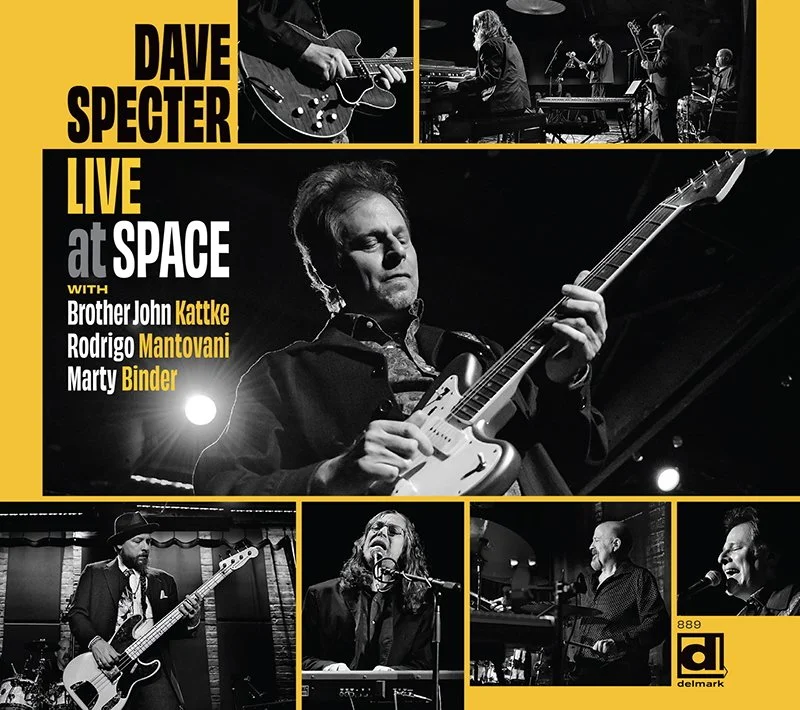
You might not be surprised to learn that Live at SPACE was recorded live in one set on one night at Space with a minuscule number of overdubs, and even though he’s one of the owners of the venue, he doesn’t think that necessarily improves the end product.
Dave sings on five cuts. Keyboardist Brother John Kattke sings on others. “John sings ‘Chicago Style,’ ‘Same Old Blues,’ ‘March through the Darkness,’ and ‘Ponchatoula Way.’ He also sings on ‘On Your Way Down’ and ‘Deep Elem Blues.’ The first record I sang on was in 2019, the record with Jorma Kaukonen. Yeah, I was perfectly content being a guitarist and didn’t really start singing on stage and on record until about six or seven years ago.”
Why not?
“Good question. I think I’ve been very lucky to play with amazing singers in the past, people like Otis Clay, Jimmy Johnson, Tad Robinson, and Barking Bill. They were so good and so powerful. I would play with guys like that, and I would think to myself, well, there is no way I could even touch them if I was singing. And I was happy with that.
Otis Clay was one of Dave’s favorite singers. ‘That’s one of the greatest times of my career was recording with him and playing a lot of shows with him – the most powerful singer I’ve ever worked with.
“Guitar was my voice, and I did a couple of instrumental records. I never thought about singing, although people like Jimmy Johnson would always say to me, ‘Why don’t you sing? You gotta start singing.’ For me, starting to sing came from finally feeling mature and developed enough as a blues artist. After playing for over 40 years, I felt like I could finally pull it off.”
It was predestined that Dave would spend his entire career with Delmark. “Another thing about Delmark that was true with Bob, and it’s also true with Julia Miller and Elbio Balilari – who own the label – is that they have always trusted me enough to just give me total artistic freedom and pretty much let me do whatever I wanted to do.
“John (Kattke on vocals and keyboards) has been a sideman in the Chicago scene for a long time, and played with people like Buddy Guy and Otis Rush. He’s in one of the house bands at Buddy Guy’s Legends; John sings and plays keyboards with me, and bass player Rodrigo Mantovani moved here from Brazil to play with Nick Moss.
“I first heard Rodrigo Mantovani at the Lucerne Blues Festival about 15 years ago and was blown away by his playing and his stage presence and his spirit. He’s a real hardcore, seasoned blues guy. He just has a great feeling and vibe and is an amazing player. He’s the youngest in the band, and it’s grand for older guys like me to play with younger cats.
“Drummer Marty Binder, the oldest in the band, was in Albert Collins and The Ice Breakers, played with Jr. Wells, also played with Buddy. He also plays classical guitar and has jazz vibes. So, yes, Marty and I have been playing together the longest, probably around 20, 25 years.”
Bob Koester put Dave on several Delmark compilation albums. “I jammed with Otis, Rush, and with Buddy many times. I’m on a couple of compilation records with Buddy and Muddy (Waters). One of the things Koester did back in the day is he would put out compilations on these labels, and I’m looking at one. I had one framed and put in my living room, on some label called Laser Light, and they put out a record called Midnight Blues. The cover had Jr. Wells, Luther Allison, Louis Myers, Little Walter, and me!
“Bob would sell the rights to various rerecords on Delmark to these labels, and they would put together various compilations – like The Blues World of Little Walter was a record that Bob put out. So, they would take a track from that. Then, they would take a track from one of my records and then combine it and put a compilation together, but Bob would never tell us.
“I mean everyone else on the records was dead. Maybe Jr. was still alive, but Bob wouldn’t say, “Hey, Dave, I just licensed one of your songs to Laser Light, and they’re gonna put out a compilation with you and Buddy Guy and one called Blues Heaven with Santana, Clapton and Bloomfield. I remember seeing that when I was in Amoeba Records in Berkeley, and I’d see it and go, ‘What is this?’”
What advice would he give young blues musicians starting out?
“Just follow your heart. Follow your heart and realize that it’s a lifelong journey, and don’t get complacent; realize there’s always room for growth. I asked John Hammond Jr. that same question and he said, ‘Get a lawyer. Get a good lawyer, man. I mean, you can get screwed over in this business.’”
Does Dave think there’s a difference between the South Side and West Side, and if so, where does he think he falls? “I think the West Side Chicago blues sound – which a lot of people talk about with players like Otis Rush and Magic Sam – is something that was created by non-musicians, by writers, maybe by fans.”
Buddy Guy would agree with Dave on that.
“Yeah, I mean Buddy is often considered part of that West Side Sound.”
I remind Dave that Buddy doesn’t like that.
“Yeah, so, I know exactly what you’re talking about. I kind of love what those people who created that term mean, but I don’t think in fact that it’s really true at all. Unfortunately, the Chicago blues scene has changed dramatically and I wish I could say for the better, but I can’t say for the better. The scene is just not. Things are just not what they used to be.”
There you have it from a native Chicago bluesman.
“Born and raised.”
