


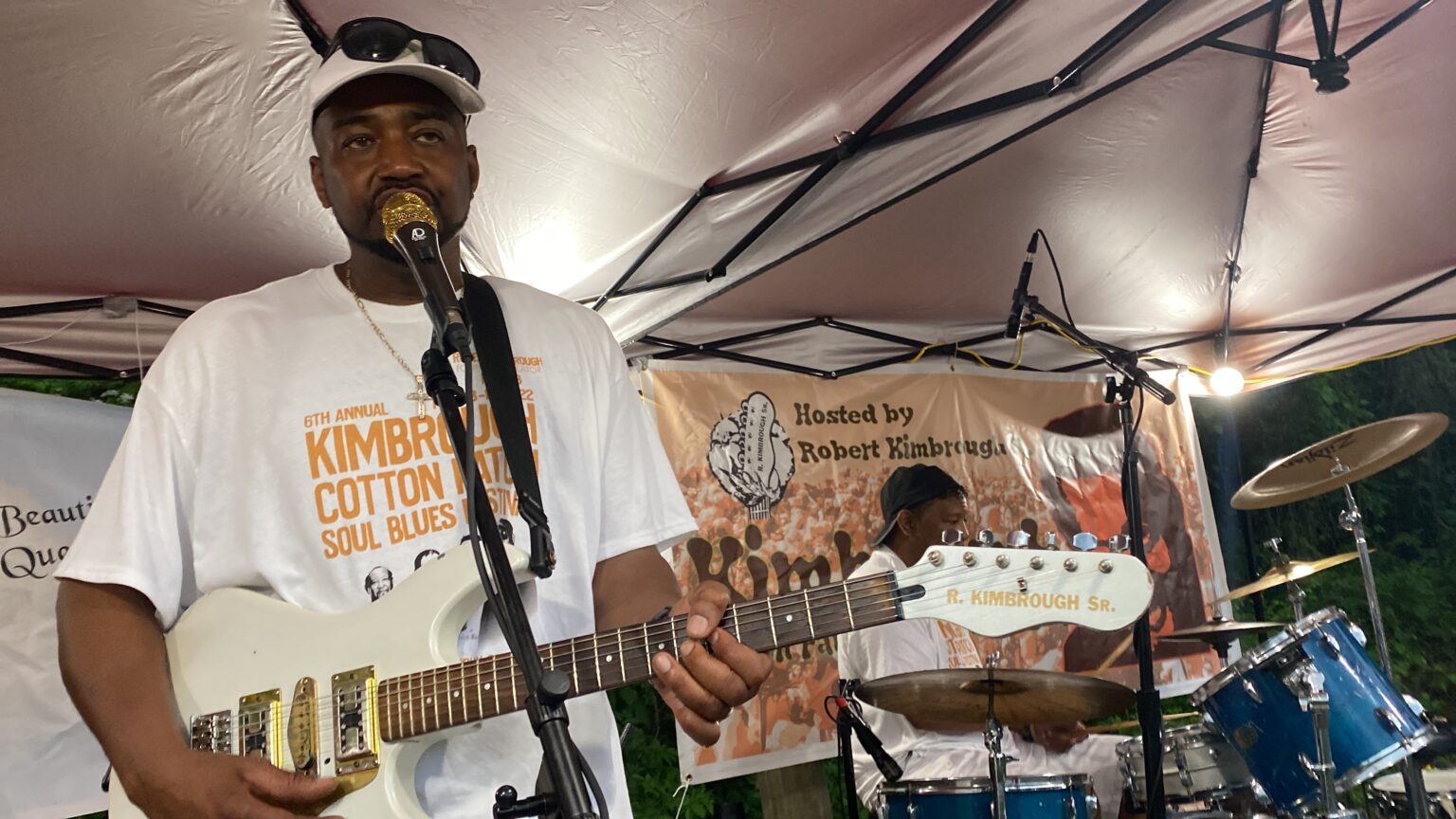
Robert Kimbrough wants to set the historical record straight.
For decades, his father — the late Mississippi blues musician David “Junior” Kimbrough — has been celebrated as a towering figure of North Mississippi Hill Country blues. His locked-in rhythms and late-night juke joint sets helped define a sound that drew listeners from around the world to a converted church in Chulahoma, Mississippi.
But according to Robert Kimbrough Sr., the historical record got something fundamentally wrong: “Cotton Patch Soul Blues was created by Junior Kimbrough,” Robert said. “He said it out of his own mouth, so you have to honor that.” This distinction matters deeply. Hill Country blues, he says, is a separate musical tradition associated with musicians like R. L. Burnside and the Burnside family – a style he respects and admires. “I love Hill Country players, man,” he said. “The boys be rocking.”
But he insists his father played something different. “Hill Country Blues and Cotton Patch Soul Blues ain’t no different than saying R&B and rock and roll.”
Rather than the jagged guitar attack often associated with Hill Country blues, Cotton Patch Soul Blues revolves around repetition, groove and feel — cyclical rhythms that stretch hypnotically beneath understated guitar lines. The music prioritizes trance over virtuosity, creating a slow-burning pulse designed as much for dancing in juke joints as for listening.
Robert described in a YouTube video what Cotton Patch Soul blues means to him, and the difference between it and Hill Country. Music historians have generally placed Junior Kimbrough within the North Mississippi Hill Country tradition. But Robert argues his father consistently described his own music instead as “Cotton Patch Soul Blues,” a distinction he has spent years trying to preserve.
The argument has become Robert’s life mission: preserving not just his father’s songs, but the identity of the music itself. Robert said the distinction is not out of rivalry, but of cultural respect.
Growing up in Holly Springs, Mississippi, Robert was immersed in the sound long before he understood what to call it. He remembers crowded house parties stretching deep into the night — yards packed with cars, his father’s band playing on the porch while his mother cooked fish, hamburgers, and hot dogs for guests.
“The blues was simply part of everyday life,” he said.
At the center of that world was Junior Kimbrough’s juke joint in Chulahoma: a converted church that became one of the most mythologized blues spaces in Mississippi. By the early 1990s, blues travelers, musicians, and fans from around the world were making pilgrimages to the club to hear Junior’s hypnotic, late-night sets unfold deep into the night.
The building burned down in 2000, two years after Junior’s death, but its influence never disappeared. For Robert, it remains a foundational site in the mythology of Cotton Patch Soul Blues — the place where the sound moved from front-porch tradition into something that reached far beyond North Mississippi.
As children, Robert and his brothers would wait for rehearsals to end before sneaking into the “band room” to teach themselves guitar. Junior Kimbrough, Robert said, never formally taught his children how to play. Instead, he taught them responsibility: work hard, take care of your family, stay out of trouble.
Robert eventually left Mississippi for Illinois after high school, but later regretted being away during a crucial period in his father’s career as Junior Kimbrough’s music began attracting international attention through Fat Possum Records in the 1990s.
Today, Robert speaks openly about what he sees as decades of misunderstanding and exploitation surrounding his father’s legacy. Among the deepest wounds is what Robert describes as the industry’s refusal to recognize the music by the name Junior himself used. Robert points to filmed interviews where his father explicitly rejected the Hill Country label and identified his music instead as “Cotton Patch Blues.”
According to Robert, Junior explained plainly that the music played by Hill Country artists in nearby clubs differed from his own hypnotic, groove-centered style. Junior identified his sound instead as “Cotton Patch Blues,” a name Robert says record labels and promoters ignored.
Music historians have classified Junior Kimbrough within the North Mississippi Hill Country blues tradition, a regional style associated with artists including R. L. Burnside, Otha Turner, and Jessie Mae Hemphill. Emerging into broader national recognition during the blues revival of the 1980s and 1990s, Hill Country blues became known for its droning rhythms, unconventional song structures, and trance-like repetition. Robert does not reject that tradition outright — he frequently praises Hill Country musicians — but argues that his father’s music drew more heavily from soul, gospel and dance grooves, forming a distinct style Junior himself called Cotton Patch Soul Blues.
“He wanted ‘Soul Blues Boys’ put on his tombstone,” Robert said. “That’s what he asked for.” According to Robert, that final request was never honored.
The dispute over genre names may sound small to outsiders, but for Robert it represents something larger: respect, ownership and historical truth. He says listeners around the world have begun reaching out after discovering the distinction themselves.
“When they say, ‘What do you mean your father played Cotton Patch Blues?’” Robert said, “I put the link out there so they can hear it for themselves.” Despite the frustration, Robert’s work is not rooted in nostalgia. He sees Cotton Patch Soul Blues as a living tradition. “As I live, that is my responsibility,” he said, “to make sure that this music is carried on and it stands firm in honor of my father.”
That responsibility has not come easily. “It’s been a struggle for me over the years,” Robert said. “People not wanting to accept the knowledge that it is what it is.” Still, he has spent years trying to educate audiences worldwide. Robert says listeners from overseas have even contacted him to apologize after learning about Cotton Patch Soul Blues for the first time. “A lot of people don’t know,” he said. “I’m just trying to straighten the board up now.”
Far from simply recreating his father’s recordings, Robert sees himself as carrying the music forward into a new generation. “It’s still Cotton Patch Soul Blues,” he said. “But we take it to another level.”
His own music builds from the rhythmic fingerpicking and trance-like repetition associated with Junior Kimbrough while adding distortion, wah pedals and heavier textures. Robert describes it as taking the foundation his parents created and “putting the icing on it.”
“We amp it up some,” he said. “That’s just a generation. That’s just how life goes.” Since launching his solo career, Robert has released six albums carrying forward the Cotton Patch Soul Blues tradition, beginning with Willey Woot in 2016 and most recently Memories in 2023. He has balanced preservation with experimentation across these albums, pushing the Kimbrough sound into heavier, funkier and more contemporary territory.
Robert writes primarily original material rather than covering blues standards. Songs often begin with grooves improvised on bass or guitar before lyrics gradually emerge. “I let the groove lock in first,” he explained. “Then I let the lyrics flow.”
He keeps a recorder nearby constantly, capturing riffs and ideas as they come. The result is music that remains rooted in the repetitive pulse of Cotton Patch Soul Blues while evolving sonically into something more expansive and contemporary.
“We may make it a little more funky,” he said. “A little more trance to grab you and pull you in.”
Robert has toured extensively across Europe and the United States, performing in countries including Belgium and the Czech Republic and appearing at major festivals overseas. But despite international recognition, he still approaches music less as commerce than obligation.
It ain’t just about money with me,” he said. “It’s about respect.” He’s carried that philosophy into the annual Kimbrough Cotton Patch Soul Blues Festival in Holly Springs, which Robert and his wife founded more than a decade ago to honor both Junior Kimbrough and Robert’s late brother David Kimbrough Jr., who died in 2019.
The festival isn’t a commercial event so much as a communal gathering rooted in the traditions of Mississippi juke joints. Visitors attend guitar workshops, jam late into the night and move freely between performances in an atmosphere Robert describes as feeling “like you at home.”
The festival draws visitors from around the United States and overseas. 2026 marked the 10th anniversary. Filmmaker Brent Moorer Gaskins, co-founder of Amethyst on Fire TV Network, has been documenting the festival and says the atmosphere feels less like a commercial music event than a communal event. “The whole room went into a mid-slow rock and sway,” Gaskins recalled during one performance. “I’ve never seen that before.”
He described musicians freely sharing instruments, strangers offering food to one another, and newcomers taking guitar workshops before stepping onto the stage themselves.
“All different races,” Gaskins said. “But the one thing in common is they love music.”
For Gaskins, one of the clearest things about Robert is that the music is not performance or branding — it is inheritance.
“Music is in his blood,” Gaskins said. “Some people have a gift and don’t want nothing to do with it. But he really embraced it. He loved this thing with all of his heart.” Gaskins said he has never heard Robert talk about wanting to do anything else. “All he talks about is this music,” he said. “It’s in his blood. This won’t be something that he’ll ever stop doing.”
The festival is proof that Cotton Patch Soul Blues still resonates far beyond Mississippi. “The Blues is here forever,” he said. “We carry the music on and try to keep it alive.” His sense of urgency deepened after the death of his brother David Kimbrough Jr. in 2019.in 2019. Robert now describes himself and his brother Kenny as among the last remaining direct torchbearers of the family’s tradition.
Yet Robert speaks about the future with determination rather than nostalgia. He continues recording new material and says he is actively working on upcoming projects, even while recovering from recent health issues that delayed studio sessions.
“This is my passion,” he said. “This is my passion. This is what I want to do in life.” Outside music, Robert runs a lawn care business and handles the everyday realities of working life in Mississippi. But everything ultimately circles back to the music: the grooves, the gatherings, the stories, and the responsibility he feels toward his father’s legacy.
“I was born in it,” he said. More than thirty years after Junior Kimbrough’s death, Robert remains focused on correcting what he believes history misunderstood — preserving not only his father’s songs, but the language his father used to define them. “I want you to feel what I’m doing,” he said. “And feel where I’m coming from.”
