


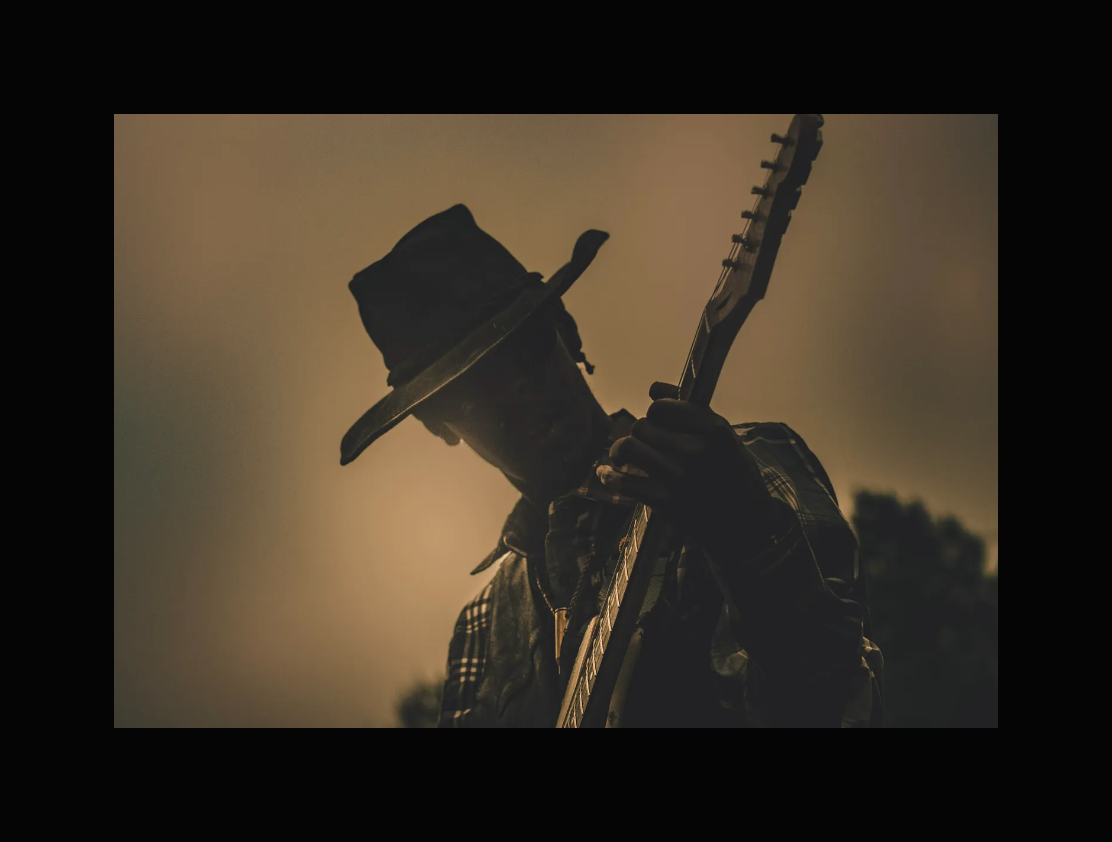
Growing up immersed in the musical culture of Holly Springs, Mississippi, Trenton Ayers took to the guitar almost as naturally as breathing, learning to play at just three years old. As he fumbled with a child-sized instrument, Hill Country blues legends R.L. Burnside and Robert Belfour performed at the intimate, often rowdy gatherings that unfolded around him. At many of those parties, Ayers’ mother welcomed neighbors and friends into their yard while Junior Kimbrough played his signature Cotton Patch Soul Blues, backed by Trenton’s father, Earl “Little Joe” Ayers, who spent more than three decades performing with the Soul Blues Boys.
Ayers said Cotton Patch Soul Blues and North Mississippi Hill Country Blues are woven into his identity and remain central to his music. Over the years, he has performed alongside Kenny Kimbrough and Gary Burnside in the Burnside Inspiration and toured extensively with the Cedric Burnside Project, helping bring Hill Country blues to new audiences while incorporating elements of rock and funk into the tradition.
Ayers said there was always a guitar somewhere in the house growing up, and no shortage of teachers. His father, brother, and uncles all played, giving him a constant source of instruction and inspiration. “When I picked it up, it’s something I knew I would do [for life],” Ayers said. “I was in a kitchen with my mother, and I walked out there because there was a funk band playing and I knew I wanted to play, perform. So I was serious about music from a young age.”
Ayers was so intent on his craft, with the guidance of his father “Little Joe,” that he delivered his first live performance at just six years old, for a birthday party in Waterfront Mississippi. Ayers said that while he could not solo exceptionally, he could “go at it” and “throw a lot of notes together,” and the crowd enjoyed the show, paying him $370 that night in tips.
“From that point on, it was like, this is truly my free will,” Ayers said.
At 10 years old, after continuing to hone his craft, Kenny Kimbrough and Gary Burnside recruited Ayers for the Burnside Inspiration. What followed was intense, marathon-length practice sessions that demanded precision, if not perfection. A collection of musicians, family (Burnsides and Kimbroughs), and friends gathered for 14 hour practice sessions in the Mississippi heat.
“I had to really rehearse. Going down to the Burnsides in a trailer. And it was hot,” Ayers said. “Everybody telling me you got this, you do this, you do this. But it ain’t no critiquing me. It made me better. I’m a real thing because I’ve been in the heat with the Burnsides.”
At just 14, Ayers opened for BB King in Lexington, Kentucky touring with the Slick Ballinger Blues Group. He had found his vocation and his calling. As a result, school seemed tedious, like a distraction from the music he was supposed to be doing.
FINDING HIS OWN VOICE
Over the years, Ayers has toured for over eight years in 22 different countries with Cedric Burnside. Both players carry forward their regional music tradition. While Ayers found lots of success and opportunities to play guitar in a supporting role within the HIll Country ecosystem, even at a young age, he said he wished he was discovered as a solo artist earlier.
Over the years, Ayer has developed an original style – one minute playing a funk beat like Prince, the next something like David Gilmour (of Pink Floyd) in tonality. Typically with Les Paul guitars, Ayers hits the top of strings to give a little punch. Ayers utilizes tight gain over pressure to achieve artificial harmonics easily. But what bleeds through the most are Ayers’ heritage and background in Cotton Patch Soul Blues and Hill Country Blues.
G Love, the musician spearheading G Love & Special Sauce and mixing together blues, rap, and rock, has been a frequent collaborator with Ayers. In 2022, Ayers, along with Mississippi musicians Alvin Youngblood Hart, Christone “Kingfish” Ingram, R.L. Boyce, Jontavious Willis, Tikkyra Jackson, and Sharde Thomas helped create a hip-hop blues record, Philadelphia Mississippi.
Earlier this year, Love characterized the album as a “hill country summit, just a blues summit.” Continuing, “The sound is authentic. I love the addition of the old-school rap, you know, my generation of rap,” Ayers said. “On the sound, it’s very bluesy and very urban, what he’s known for.”
Ayers added that Love is a down-to-earth guy and that recording went smoothly. Many G Love fans, including hip hop fans, have ventured into Hill Country Blues as a result of the record, giving more exposure to the genre, according to Ayers.
A FATHER-SON LEGACY
Ayers released his first solo LP debut with 2023’s A Father-Son Legacy. The album emerged as the younger Ayers saw his father getting old. While the pair had played together frequently, the father-son duo had never recorded together. Ayers said that he wants future generations of the family to know how they arrived where they are musically, and the style of Hill Country the Ayers men played. “The family can go back and listen to us – our great-great-great-great-great-grandchildren.”
One of the greatest honors of his career, Ayers said, was receiving a grammy nomination in 2016 for his work with Cedric Burnside on Descendants of Hill Country. The album bore fruit out of many weeks working together in the Mississippi heat along with Cedric’s uncle Gary Burnside. In one day “cooking in the heat,” the trio produced five songs that would appear on the LP.
When news reached of the grammy nomination for the Best Blues Album of the year, Ayers was flooded with congratulatory phone calls, but his father didn’t grasp the magnitude of the achievement at first, according to Ayers. “Little Joe” was not into awards, but after Trenton explained the award, he heartily congratulated his son. For the award ceremony, held in February, near his mother’s birthday, Ayers wore a blue suit commemorating her.
THE SOUND OF HILL COUNTRY
As a simple, general distinction, Ayers said Burnsides typically play Hill Country while Kimbroughs play Cotton Patch Soul, but in the collaborative inbred community, such distinctions do not always stand strong. “We live in the Northern Hills of Mississippi, so that’s how it get named, you know. But Junior Kimbrough, his stuff was different. He was more soulful,” Ayers said.
In both cases, the genres force people to move and dance, according to Ayers. “Both of them can make you get up, get up, you can dance and all that. Junior really specializes in love making, that type of audience,” Ayers said. “To be honest with you, it’s all one big feeling to me. It’s all a great feeling. Because I’m rooting for both of them. I’m proud of both of them. I love them both. if you want to, want to party and dance, I would prefer Hill Country Blues. If you want to be in a soulful temptation, float it, you know, get a Junior Kimbrough.”
For Ayers, Hill Country Blues and Cotton Patch Soul Blues are distinctive not only for their sound, but for the way they are constructed. While the styles readily absorb influences from other genres, they often reject the predictable structures many musicians are trained to follow.
Ayers also sees parallels between Hill Country blues and Jamaican music, particularly rocksteady, arguing that the connection extends beyond rhythmic similarities to the stories they tell. Like Hill Country blues, rocksteady grew from an expressive musical tradition, but its songs were often centered on love and romance, reflecting the influence of American soul music on Jamaican artists. By contrast, Ayers said roots reggae emerged from the realities of Kingston’s ghettos and more directly confronted poverty and social struggle. He sees a similar distinction within the blues, noting that traditional blues often chronicled lived experience and hardship, while much contemporary blues has shifted toward themes of love, relationships, and celebration.
Even songs shared within the tradition can diverge dramatically—Ayers points to Junior Kimbrough’s and R.L. Burnside’s versions of “Po’ Black Mattie,” which carry a similar spirit but sound markedly different. Some songs remain anchored to a single chord, while others follow unconventional progressions. “Do the Rump,” for example, stretches its solo to 15 bars before returning to the one, with few harmonic changes along the way. Alternate tunings, fluid arrangements, and departures from the standard 12-bar blues form all contribute to a style that Ayers believes is difficult for outsiders to master.
Even formally trained musicians can find themselves lost when playing Hill Country blues, Ayers said. He recalled Berklee-trained players missing turnarounds and transitions because they expected the music to follow familiar blues patterns. Hill Country musicians, he said, may use elements of traditional blues, but they arrange and interpret them according to a musical language all their own—one rooted in North Mississippi rather than the rulebook.
“We do all of that, but we do it in our own style. We got our own book. We got our own tree,” Ayers said. “If we are playing this song and I’m leading the charge, you got to be on my timing, on how I’m doing it, and you ain’t going to get that [without steeping in the music and culture]. Regardless of who you are, what your background is. I ain’t found one yet.”
Within the genre, Ayers sees significant freedom for interpretation, innovation, and change. Ayers noted that several musicians have versions of “Do the Rump” by Junior Kimbrough. “We all kind of do our stuff there,” he said.
WHY THE MUSIC MATTERS
Much earlier, as a child, was the first time Ayers recognized his family and community possessed a unique musical talent, tradition, and craft. At a house party, on a typical Saturday, his father “Little Joe” played and people from California, New York, Denmark, and Africa showed up. A month later, it happened again. Trent asked himself, “what’s going on?”
With the convergence of Fat Possum’s work as a major label to promote blues from North Mississippi RL Burnside and Junior Kimbrough emerged as the biggest stars, achieving a minor celebrity among certain blues fans. Two documentaries – Deep Blues: A Musical Pilgrimage to the Crossroads (1991) and You See Me Laughin’: The Last of the Hill Country Bluesmen (2002)– brought more exposure.
As he grew older, Ayers discovered just how much weight those names carried. Audiences were often astonished to learn that he was Little Joe Ayers’ son, related to the Kimbroughs by blood, and had even shared the stage with Hill Country blues icons R.L. Burnside and Junior Kimbrough.
An amazing fact for the Hill Country community at large, and also specifically for their largest emissaries in Junior Kimbrough and RL Burnside, is that the musicians grew up in Northern Mississippi and decided to stay there, aside from touring, for almost the entirety of their lives. This strongly contrasts the waves of immigration of Delta
Blues musicians who traveled to Northern cities like Chicago and Detroit.
“They stayed home, and that’s why they mean so much to the community as well. They helped a lot of people, directly or indirectly with their music,” Ayers said. “ Mr. RL’s music. I have performed it in other parts of the world, people come up to me crying type stuff. This music touches and helps people on an emotional level.”
Juke joints in Northern Mississippi were a gathering place for the community and music, Ayers said. People could hang out, get off work, and let worries out, listening to music at Junior’s club. “You’re going out to Junior’s or wherever the party [is] at,” Ayers said.
“Icons built these places where you can go and talk to them and be a part of them and dance and let the worries out,” Ayers said. “And we can talk about cultural things if we need to, or we can just sit back and just chill.”
CARRYING THE TRADITION FORWARD
While feeling nostalgic about the music scene he grew up in, Ayers said he is concerned with a generational gap, with younger audiences favoring other genres.
“Can we recapture it? There’s a generational gap of caring and wanting to be there,” Ayers said. “They ain’t trying to listen to Howlin’ Wolf and Muddy Waters and Charlie Patton now, you know. To them, they ain’t going to call it slave music, but they can’t dig it, right?”
Ayers added that most people, even in MIssissippi don’t listen to the R.L. Burnsides, or even the LIghtnin’ Hopkins’ of the blues world. Hill Country blues has produced globally influential artists and inspired countless musicians, but it has not had a major mainstream crossover star from North Mississippi in recent decades.
Yet, a hidden influence exists; for Ayers, blues is the water of all music, and blues created rock n’ roll. Ayers hopes Hill Country blues emerges as a key inspiration for music 20 years down the line, and hopes it can financially provide for the artists. From a general feeling, Ayers believes that Hill Country is healthy and growing. One indication, Ayers said, is that there is a band on YouTube who posted a video doing a cover of one of his songs.
Preserving the music and sound of Northern Mississippi is important to Ayers, though he said he adapts to the musical tastes of the crowd when performing. Among others, Ayers said that Stud Ford, Cameron Kimbrough, and Yella P are taking significant steps to preserving Northern Mississippi music styles.
Hill Country Blues is a musical style, a culture, and a place, according to Ayers. He said that he hopes music historians get key facts right about the genre, so 100 years down the line people can learn about Hill Country blues, and for information to be educational. “It means heritage and legacy because that’s what it is to me. It’s my blood,” Ayers said.

Moving forward, Ayers plans to release an album on September 4 titled Taking it to the Mountain, a nine track LP recorded at Music Maker Studios in Fenton, North Carolina and produced by Jimbo Mathus. Ayers said there will be a listening circle/party for the album on August 1.
